


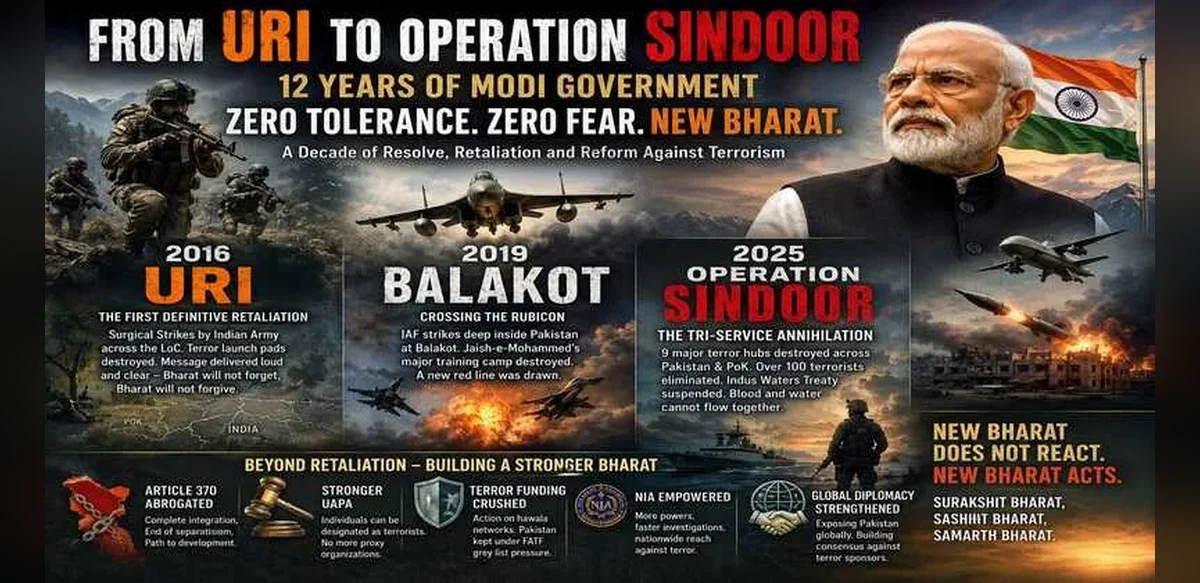
When the current Indian leadership took power in 2014, the country confronted recurring security challenges. Cross-border terrorist incidents typically prompted diplomatic complaints, global outreach, and few other choices. For many years, India’s approach to such threats emphasized caution due to risks of wider conflict and regional fallout.
After twelve years, the nation’s security framework has changed substantially. Successive administrations have shifted emphasis from restraint toward prevention. Officials have signaled that terrorist acts would face direct responses and that protecting citizens takes priority over previous calculations.
This evolution involved concrete actions at three key moments: Uri, Balakot, and Operation Sindoor. These events helped shape what observers call a firm stance against terrorism.
Uri marked an early demonstration of the updated approach. The 2016 assault on an army post that killed nineteen soldiers prompted a swift reply. Special units crossed the boundary line and targeted militant facilities in the disputed area, damaging several sites used for infiltration.
The public confirmation of the cross-boundary action conveyed a clear signal. It ended a period when such attacks received mainly diplomatic replies. The move showed both capacity and resolve to act against sponsors of violence.
Balakot broadened the scope further. Following the 2019 attack that killed forty paramilitary personnel, air force jets struck a training site well inside neighboring territory. This step indicated that recognized borders would not shield groups involved in attacks.
It was the first such aerial mission into the heartland since 1971. The action raised the perceived costs for supporting militant activities and set a revised deterrence standard in the region. Officials stressed that incidents would receive visible, measured replies rather than being viewed in isolation.
Operation Sindoor tested the matured capabilities in 2025 after an attack on visitors in a tourist area. The response combined army, navy, and air assets with drone swarms, precision munitions, and real-time intelligence. Multiple sites were hit at once.
The effort highlighted improved coordination and technology use built over the prior decade. It also paired military steps with diplomatic and economic measures, including a pause in a major water-sharing agreement, reflecting a wider strategy.

