


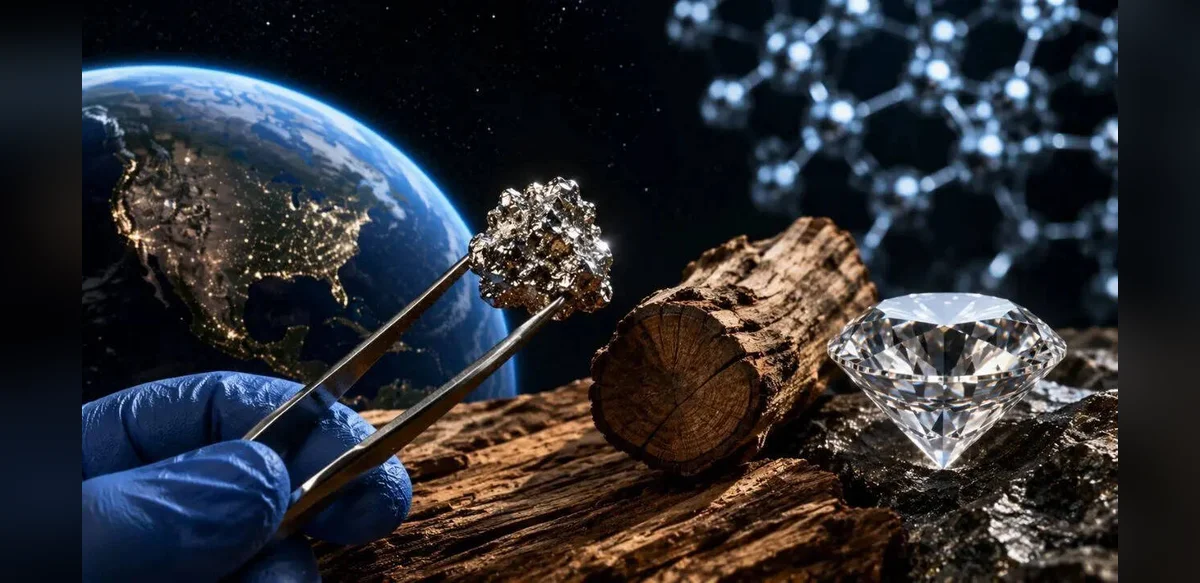
Pressure, heat and time shape diamonds in planetary interiors and interstellar space. Ice giants like Uranus and Neptune host conditions where carbon compounds break down and reform as crystals. Laboratory models and data from Voyager missions support these processes. Telescopes also detect nanodiamonds in dust clouds between stars. These formations occur without biology.
Wood arises differently. It develops only in living systems that perform photosynthesis, transport fluids and assemble polymers such as cellulose and lignin. Growth rings record seasonal changes and environmental stress. No such structures appear in planetary atmospheres or meteorites.
Carbon atoms can create graphite, fullerenes or diamonds under thermodynamic conditions alone. Supernova remnants likewise produce microscopic diamonds that reach new star systems. None of these outcomes need enzymes or metabolism.
Wood depends on sustained energy flow, compartmentalization and evolutionary adaptation. Organic molecules found in meteorites show chemistry without life. Earth remains the only known location where all required conditions have produced forests.
The comparison highlights two distinct categories. One results from physical forces acting on atoms. The other requires self-sustaining biological systems. Detecting diamonds elsewhere reveals little about biology, whereas evidence of wood-like structures would indicate far more.

