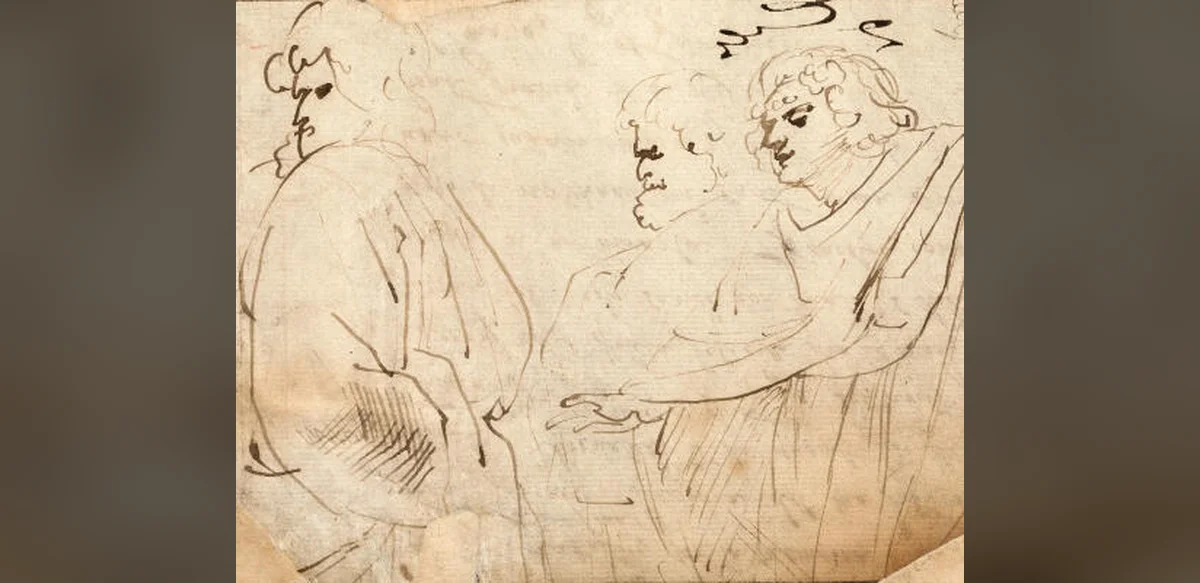
More than 400 years ago, the rising Flemish painter Peter Paul Rubens walked the streets of Rome with a notebook, drawing from Renaissance artworks in the city’s churches and palaces. A rare sheet believed to come from his Roman sketchbook is now on display in his hometown of Antwerp, offering fresh insight into the baroque master. Shown publicly for the first time, the double-sided sheet has a drawing on one side and part of a draft letter on the other. Rubenshuis curator An Van Camp believes it likely belonged to a sketchbook Rubens used while living in Rome with his brother Philip near the Spanish Steps. One side shows a quick brown-ink sketch of three men in classical robes, possibly apostles, with thick jagged lines at the top where Rubens tested his pen. The figures do not appear in any known Rubens work, and it is unclear if he invented them or copied them from something seen in Rome. The reverse holds an unfinished draft letter to Italian painter Cristoforo Roncalli, who had been asked by their shared patron, Eleonora de’ Medici, Duchess of Mantua, to create a painting for her private chapel. Rubens worked at the Mantua court from 1600 to 1608. In the September 1607 letter, the 30-year-old Rubens inquires about the painting’s progress on behalf of his “most serene mistress.” Van Camp noted the diplomatic tone and the artist’s effort to balance politeness with urgency. The handwriting is uneven, with corrections showing his search for the right words. The letter provides a glimpse of Rubens as an emerging diplomat. The sheet adds to the Rubenshuis collection, which holds only two drawings and ten letters by the artist, all from later years. It is currently part of the interactive Rubens Experience exhibition and will move to his Antwerp home after renovations expected to finish no earlier than 2030. Few of Rubens’ works remain in Belgium. Many paintings went to Madrid and Vienna under Spanish and Austrian rule, while drawings were acquired by English and French collectors in the 18th and 19th centuries. The King Baudouin Foundation bought the sheet for Belgium for €110,000, below the €145,000 asking price, after the US owner agreed to a discount for public display. Foundation official Melanie Coisne said the purchase met all criteria, as it was a rare work by a noted Antwerp artist that gave “a real insight into who Rubens actually was.” Rubens left Italy in 1608 after learning his mother was ill. He arrived in Antwerp too late to see her but settled there as major commissions arrived. He never returned to Italy yet signed as Pietro Paolo Rubens for life and redesigned his Antwerp house in the style of ancient Rome and the Renaissance.