


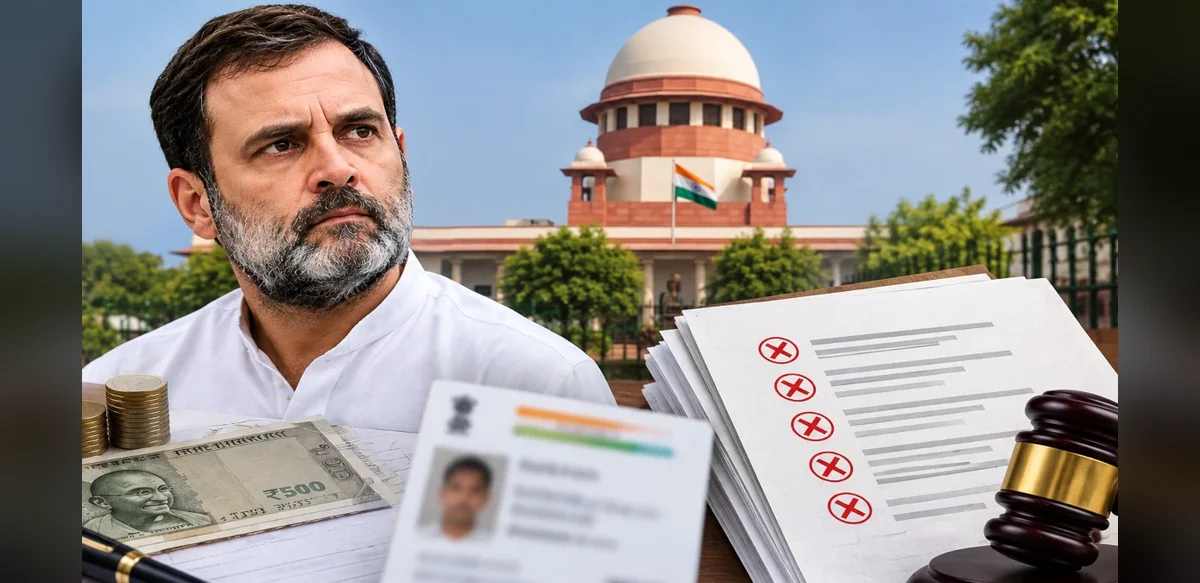
The Supreme Court registry has identified fourteen procedural shortcomings in a petition filed by opposition leaders contesting the Election Commission’s Special Intensive Revision of voter lists. The filing, led by Congress figure Rahul Gandhi, seeks judicial review of the revision process across multiple states. Among the noted issues is a minor shortfall of two hundred twenty rupees in the required court fee. Additional concerns involve missing authorizations from nine of the petitioners and an unclear copy of an identity document belonging to Congress president Mallikarjun Kharge.
These administrative observations have delayed the listing of the matter for hearing. Petitioners are required to address the flagged items before the case can advance. The petition was submitted on October twelfth, coinciding with a public demonstration in central Delhi by members of the INDIA bloc. Demonstrators expressed concerns over alleged irregularities in the revision exercise and called for its suspension.
The registry objections cover several categories of documentation problems. They include the absence of formal lawyer authorizations known as vakalatnamas from nine petitioners. There are also discrepancies in the naming of certain respondents and a lack of explanation for including private individuals in that list. Further points involve missing pages from the filing, inconsistencies in page numbering, and text that appears dim or difficult to read. Some pages are in regional languages without accompanying translations, while others use fonts considered too small. Two documents were submitted only in black and white rather than color.
The petition names the Election Commission of India along with Chief Election Commissioner Gyanesh Kumar and two other commissioners as respondents. It requests that the court summon records related to the revision and assess whether decisions taken comply with constitutional provisions and statutory rules. One central request is the formation of an independent committee led by a retired Supreme Court judge. This committee would be supported by technical specialists and would review deletions and alterations made to electoral rolls within a set period.
Additional prayers seek protections ensuring that no voter is removed from the rolls without prior notice and an opportunity to respond. The petitioners also ask that eligible individuals in states approaching elections, including Punjab, be permitted to apply for inclusion up to the legally allowed deadline. Interim relief is sought in the form of a temporary halt to the ongoing revision while the court considers the substantive questions.
The demonstration in Delhi included a request for a meeting with the Chief Justice of India. The request was declined on the ground that the issues were already before the judiciary. The Chief Justice noted that the court remains accessible to all citizens and representatives seeking remedies through proper channels. The petition references Article 324 of the Constitution, which assigns the Election Commission responsibility for superintendence and control over electoral roll preparation.
It further cites provisions from the Chief Election Commissioner and Other Election Commissioners Act of 2023. The legal challenge raises questions about the scope of the commission’s authority and the safeguards available to voters. However, these substantive matters remain separate from the current procedural requirements that must be fulfilled first.
The INDIA bloc has conducted a visible political campaign highlighting claims of voter deletions and irregularities. Leaders have demanded the resignation of the Chief Election Commissioner and a return to paper ballots in future polls. The list of petitioners includes representatives from several parties such as Trinamool Congress, Samajwadi Party, Rashtriya Janata Dal, Nationalist Congress Party, Shiv Sena, Communist Party of India, and others.
The immediate effect of the registry observations is a postponement until corrections are completed. The legal team must now prepare revised documents addressing each of the fourteen points. Once resubmitted and accepted, the matter can proceed toward listing and potential hearing. The current stage is limited to administrative compliance rather than any evaluation of the underlying claims.
Observers note that such preliminary checks are standard in high-volume filings at the apex court. The process ensures that all required materials are complete and properly presented before judicial time is allocated. The petitioners retain the option to cure the defects and pursue the case further. No timeline has been indicated for when the corrected petition might be taken up.
The Special Intensive Revision exercise itself continues in the affected states pending further orders. The Election Commission maintains that the process aims to improve the accuracy of voter rolls. The opposition maintains its position that greater transparency and independent oversight are necessary. Both sides await the next procedural step in the litigation.


