


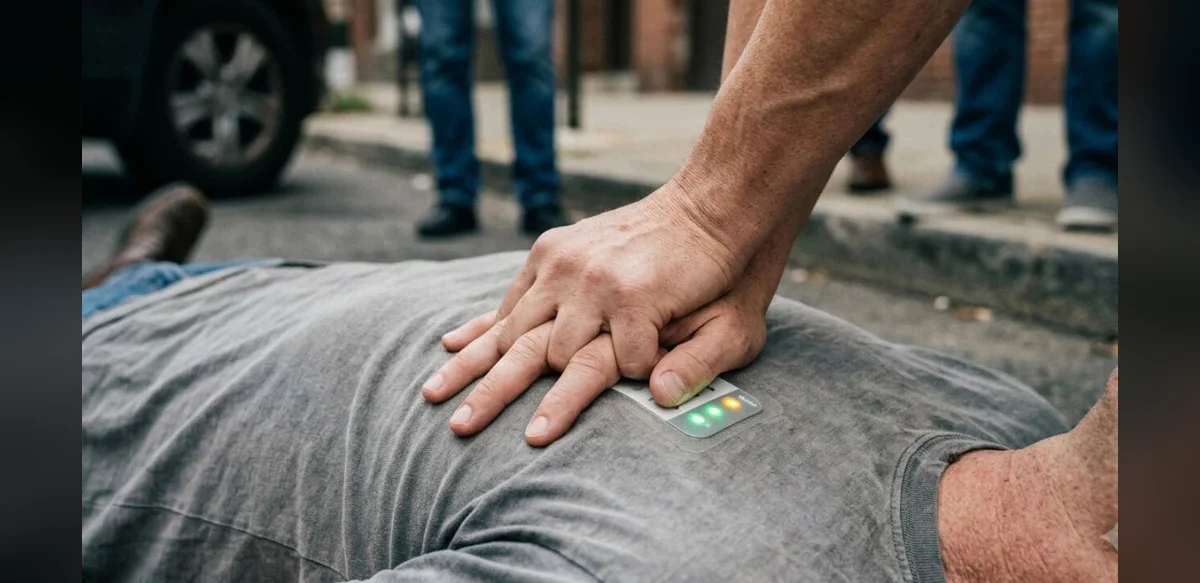
A team of four students from the University of Washington has created a compact device designed to assist individuals performing cardiopulmonary resuscitation. The invention, known as CPRight, takes the form of a small patch comparable in size to a wallet. It employs light-emitting diodes to offer immediate visual instructions on the proper depth and rhythm of chest compressions.
Performing CPR correctly remains a critical challenge in emergency situations. Many rescuers struggle to maintain consistent pressure and timing without specialized tools. The new patch addresses this issue by delivering feedback directly through its illuminated indicators. Users can adjust their actions in real time based on the signals, all without connecting to extra machinery or software.
The development process focused on simplicity and portability. By keeping the unit lightweight and self-contained, the students aimed to make it practical for everyday carry in first aid kits or personal belongings. Testing reportedly showed that the visual cues help maintain recommended compression standards established by health authorities.
This project earned recognition at the 2026 Collegiate Inventors Competition. The undergraduate team received the top prize of ten thousand dollars for their category. The annual event highlights student-led advancements across multiple fields, including treatments for cancer, methods for physical rehabilitation, and systems for monitoring neurological conditions.
Judges noted the potential for the patch to support both trained professionals and lay responders during cardiac events. Its design avoids reliance on electronic displays or mobile applications, reducing barriers in high-stress environments where equipment may be limited.
Broader discussions around emergency medical training emphasize the value of accessible aids. Devices like this one could complement existing mannequins and courses by providing on-the-spot reinforcement. The emphasis on minimal setup aligns with goals of increasing survival rates through more effective bystander intervention.
The competition itself serves as a platform for emerging talent in science and engineering. Participants present prototypes that solve practical problems, often drawing from personal experiences or observed gaps in current practices. Awards encourage further refinement and possible commercialization pathways.
While the immediate focus remains on chest compression guidance, the underlying technology could inspire similar feedback mechanisms in other medical training scenarios. The students expressed interest in exploring refinements based on additional user input from emergency responders.
Public health experts continue to stress the importance of widespread CPR education. Tools that simplify the learning curve may contribute to higher confidence levels among those who encounter sudden cardiac arrest outside hospital settings. The wallet-sized format supports easy distribution in community programs.
Overall, the achievement underscores the role of university initiatives in fostering inventive solutions. By combining engineering principles with clinical needs, the team produced a prototype that stands out for its straightforward approach. Future iterations might incorporate additional sensors while preserving the core advantage of equipment-free operation.
The recognition at the national level brings visibility to undergraduate research efforts. Such competitions often lead to collaborations with industry or further academic pursuits. The ten-thousand-dollar award provides resources for continued development and testing.
In summary, the CPRight patch represents a thoughtful response to a persistent challenge in lifesaving procedures. Its success at the Collegiate Inventors Competition highlights both the ingenuity of the creators and the ongoing need for practical innovations in health-related fields.

