


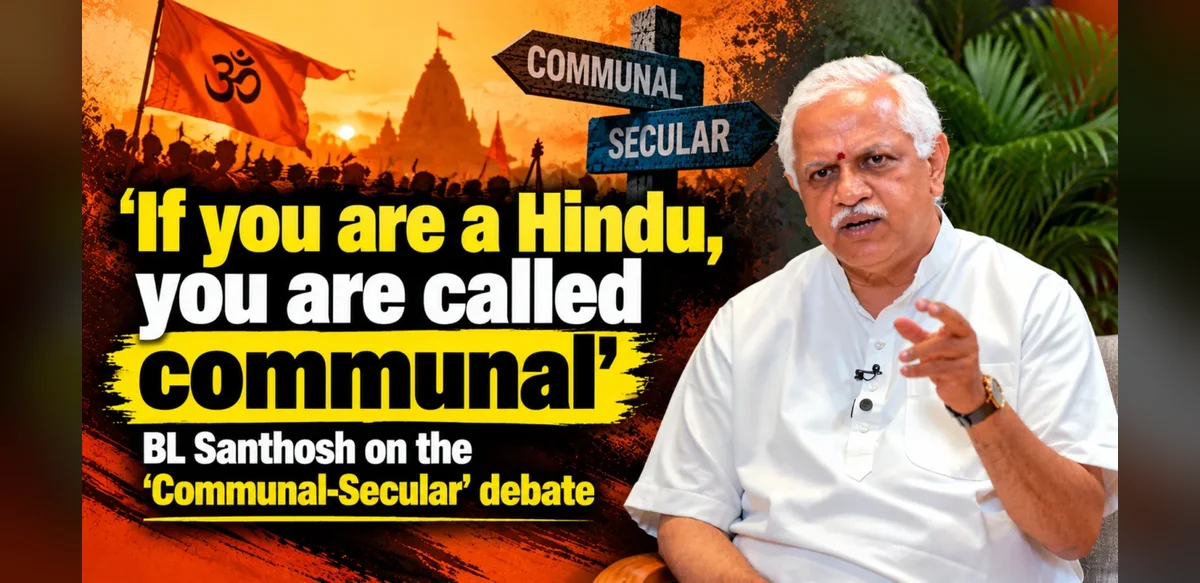
BJP National General Secretary responsible for organisational matters B L Santhosh has stated that the expressions communal and secular have taken on specific political connotations within India. He noted that declaring oneself Hindu is frequently portrayed as communal while criticism of Hindu customs is framed as secular. These observations were shared during an interview focused on the ideological effects of the Ram Janmabhoomi movement and the broader evolution of political terminology.
Santhosh explained that the words no longer function as neutral descriptors in everyday socio political interactions. He illustrated the point by describing how an individual who identifies as Hindu within family settings or during public activities is routinely categorised as communal. In contrast he observed that those who oppose established traditions or religious practices associated with Hindu society are immediately presented as secular. This pattern according to him has become a recurring feature of public debate.
The discussion placed these remarks in the context of the Ram Janmabhoomi movement which Santhosh described as a turning point for the party. He recalled that the decision to participate was made during the Palampur session and was framed as support for a social cultural and religious initiative rather than a purely electoral strategy. The movement he said enabled the organisation to extend its reach beyond its previous strongholds and to establish a presence in additional regions across the country.
Santhosh further noted that the campaign introduced the term pseudo secularism into wider circulation. He suggested that the episode encouraged ordinary citizens to scrutinise the application of secular principles and to distinguish between what he termed genuine and superficial interpretations. This shift in public awareness he argued represented one of the lasting contributions of the movement to political vocabulary.
The interview also traced the party trajectory from its origins in the Bharatiya Jana Sangh to its current form. Santhosh linked this development to the concepts of cultural nationalism and economic nationalism which he presented as interconnected elements of the party outlook. He emphasised that ideas once considered peripheral have moved into the mainstream of national conversation over time.
Throughout the conversation Santhosh maintained that the communal secular distinction has become central to ideological exchanges in India. He described how the Ram Janmabhoomi movement prompted greater public engagement with these themes and contributed to organisational growth. The remarks were offered as part of a longer reflection on the party history and its adaptation to changing political circumstances.
The source material consists of an interview conducted for the Organiser YouTube channel. Direct statements have been drawn from the provided transcript while acknowledging that automated transcription may contain minor variations from the spoken record. The account remains focused on the arguments presented without introducing external commentary or additional claims.
Additional context from the interview highlights the movement role in broadening acceptance of the party across diverse geographic areas. Santhosh pointed to increased visibility of nationalist groups as another outcome. He connected these developments to a gradual transformation in how political labels are understood and deployed by both leaders and the public.
The overall narrative underscores the party emphasis on ideological continuity from earlier decades to the present. Santhosh positioned the Ram Janmabhoomi episode as a catalyst that clarified distinctions between different approaches to secularism. This clarification he suggested empowered citizens to question established narratives and to participate more actively in discussions about national identity and tradition.
In summary the interview presents a perspective on how terminology shapes political life and how specific campaigns have influenced organisational reach and public discourse. The statements remain consistent with the party stated positions on cultural and religious matters while avoiding direct references to competing groups or individuals. The length of the discussion allows for repeated emphasis on the movement significance in altering perceptions of communal and secular categories.
Further elaboration in the interview touched on the complementary nature of cultural and economic nationalism within the party framework. Santhosh described these strands as mutually reinforcing and essential to the broader ideological project. He concluded by noting that the Ram Janmabhoomi movement served as a practical demonstration of these principles in action leading to sustained organisational expansion.
The interview format provided space for detailed recollection of past decisions and their consequences. Santhosh used the opportunity to connect historical events with contemporary understandings of political language. This approach allowed listeners to follow the progression of ideas from the Jana Sangh era through the Ram Janmabhoomi period to the present day.
Overall the content offers an internal account of how one senior party figure views the evolution of key terms and the impact of major campaigns on public consciousness. The narrative stays within the bounds of the supplied transcript and maintains a focus on factual reporting of the statements made.

