


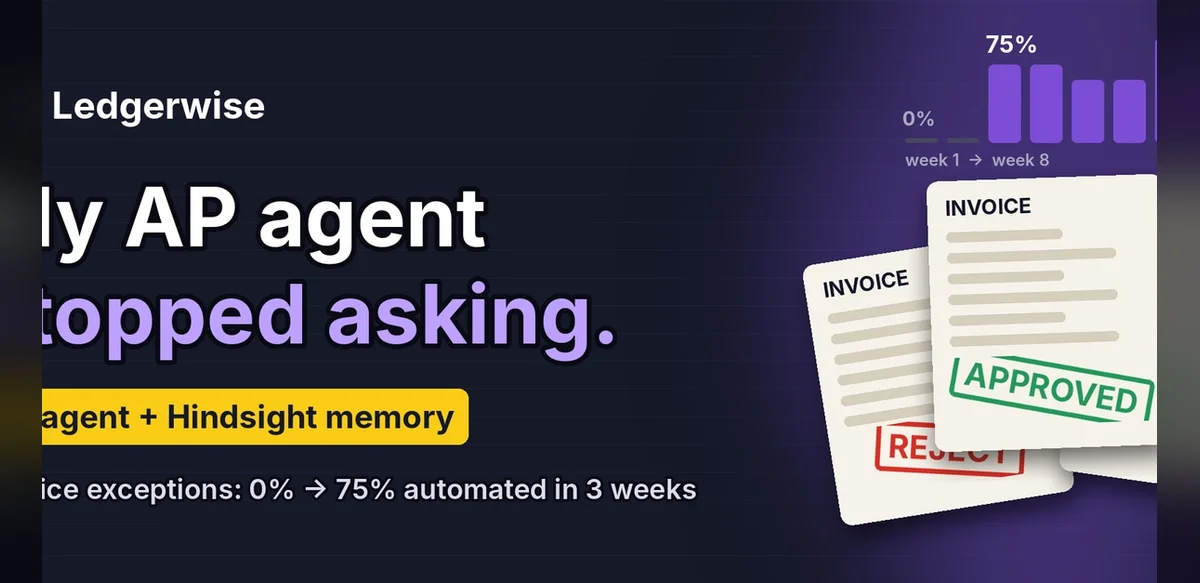
In accounts payable operations, discrepancies between purchase orders and incoming invoices create recurring challenges for finance teams. A common example involves steel distributors submitting monthly bills that exceed agreed pricing by three percent. Traditional automated systems flag these differences and route them for human review, leading to repeated queries and delays.
To address this pattern, developers introduced a hindsight memory feature to the accounts payable agent. This capability allows the system to retain records of prior resolutions and apply learned adjustments without generating new alerts for similar cases. Once implemented, the agent began processing invoices independently when the variance matched previously resolved instances.
The change reduced the volume of routine questions directed at staff. Instead of seeking confirmation for each three percent overage, the agent referenced its stored history and completed the transaction. This approach maintained accuracy while minimizing interruptions in daily workflows.
Finance departments often face high volumes of repetitive invoice reviews. By incorporating memory of past decisions, the agent demonstrated improved efficiency in handling consistent supplier behaviors. The system continued to escalate novel discrepancies that fell outside established patterns.
Implementation required careful calibration to ensure the memory function did not overlook legitimate variations in pricing or terms. Testing involved reviewing historical invoice data to confirm that the agent applied adjustments only when conditions aligned closely with prior examples.
The result was a noticeable decline in manual interventions. Staff reported fewer routine approvals and more time available for complex financial analysis. The agent operated within defined parameters, preserving oversight for any transactions that deviated from learned norms.
This development highlights ongoing efforts to enhance automated financial tools through targeted memory mechanisms. Such features aim to balance autonomy with reliability in environments where recurring data patterns are common.
Further refinements could expand the agent’s ability to recognize additional invoice types while maintaining the core principle of learning from resolved cases. The initial application focused on pricing variances but suggests potential for broader use in accounts payable processes.
Overall, the integration of hindsight memory transformed the agent’s interaction style from frequent inquiries to independent action on familiar issues. This shift illustrates one method for streamlining repetitive financial tasks without compromising established controls.

