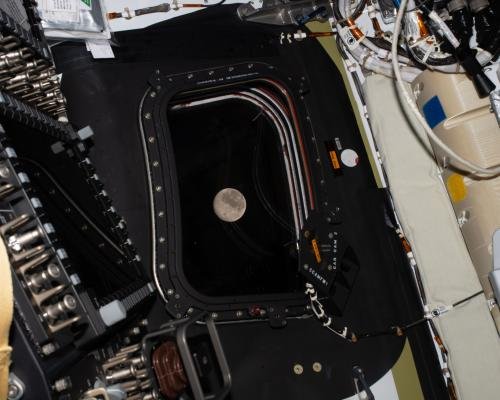
On Monday at 1:57 p.m. Eastern Time, the Artemis II astronauts eclipsed the distance record established by Apollo 13. The four crew members embraced in their compact spacecraft as they became the first humans to venture farther from Earth than any previous mission. Prior to reaching this milestone, the team lowered the cabin lights and gathered at the windows in anticipation of the record-breaking moment during their non-landing pass by the moon, with intentions to loop back toward Earth. Canadian astronaut Jeremy Hansen transmitted, ‘The view of the moon with the unaided eye is astonishing right now. It’s truly remarkable.’ He urged current and future generations to ensure this accomplishment is soon surpassed. The crew consists of NASA astronauts Reid Wiseman, Victor Glover, and Christina Koch, along with Hansen from the Canadian Space Agency. They are set to travel approximately 5,000 miles beyond the moon, surpassing the Apollo 13 mark from 1970 by about 4,000 miles. Their tasks include documenting observations of the moon through notes, audio logs, and reports on crew positioning, any overlooked features, unexpected sightings, descriptions of lunar sites, and their personal responses during the flyby. The astronauts are instructed to identify various lunar formations, such as highlands, marshes, bays, seas, and lakes—terms coined by 16th-century scientists like Galileo and Johannes Kepler for basalt-filled craters, though these lack actual water or vegetation unlike Earth’s equivalents. The Apollo 13 team—commander Jim Lovell, Fred Haise, and Jack Swigert—reached a peak distance of 248,655 miles from Earth during their emergency trajectory before heading back. On Monday, Hansen noted that the astronauts had proposed