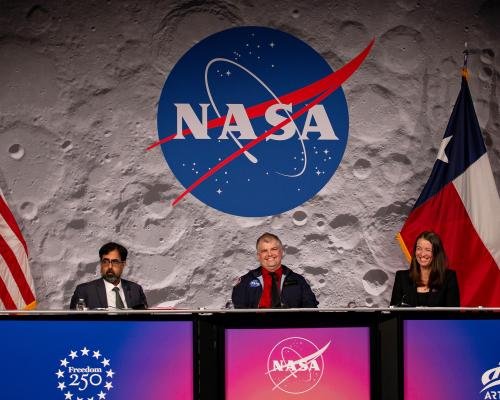
The astronauts from NASA’s Artemis II mission are due to come back to Earth on Friday after completing a groundbreaking 10-day trip that took them around the moon. Agency officials have explained the exact procedures required to ensure their secure arrival. The Orion spacecraft will re-enter the atmosphere at speeds approaching 24,000 miles per hour before landing in the ocean several miles from San Diego’s shoreline. This process involves various teams working together meticulously to retrieve the crew from the vessel. During a Thursday press briefing, NASA’s associate administrator Amit Kshatriya stated: ‘To every engineer and technician who has worked on this vehicle, tomorrow is your moment. The crew has fulfilled their role; now it’s our turn.’ Jeff Radigan, the mission’s lead flight director, highlighted the need for accuracy in the re-entry trajectory, pointing out that the team has ‘less than one degree of margin’ for the proper angle. ‘We must achieve that precise angle, or the re-entry won’t succeed,’ he explained. Radigan described the sequence of events for the spacecraft’s descent. The crew module and service module will detach at 4:33 p.m. PT (7:33 p.m. ET, 12:33 a.m. UK time), with the service module disintegrating upon atmospheric entry. A subsequent adjustment burn for the crew module is planned at 4:37 p.m. PT, followed by atmospheric interface at 4:53 p.m. PT, leading to a short communication loss. Drogue parachutes will activate around 5:03 p.m. PT, then the primary parachutes, culminating in splashdown at 5:07 p.m. PT. He noted that the landing site is well offshore from southern California. ‘Given our approach path, it won’t be observable from the California coast… We’re coordinating with the Department of Defense for capsule retrieval, and there’s a substantial restricted area, so we advise the public to steer clear,’ Radigan said. ‘Various pieces detach during descent, and our teams manage this to prevent any issues,’ he continued. Branelle Rodriguez, manager for the Orion vehicle in the mission, described the anticipated fragments: ‘Upon re-entry, the crew module’s forward bay cover detaches, deploying the initial parachutes.’ She mentioned that three parachute groups are released sequentially, dropping into a designated exclusion zone in the water that people should avoid. The USS John P. Murtha is prepared to support the recovery, which will proceed in phases and last approximately one to one and a half hours. ‘We need to methodically deactivate several systems, and the crew must reorient and secure the spacecraft before opening the hatch, which requires some time,’ Radigan explained. He added that retrieval teams will initially keep their distance. ‘Meanwhile, the recovery personnel must remain several miles away due to falling components.’ ‘After verifying no hazards remain, which only takes minutes, they can move in to start crew extraction… It requires time to position the teams at the capsule, assist the astronauts out, and onto the recovery platform attached to the spacecraft,’ Radigan said. Once removed, the crew will receive medical checks after the flight and then be transported to NASA’s Johnson Space Center in Houston, Texas. The Thursday session came after a Wednesday update where the Artemis II team shared thoughts on their experience. Pilot Victor Glover, the first Black individual to venture past low Earth orbit, remarked: ‘We need to return. You’ve seen some data already, but the best is coming back with us. There are many more images and accounts.’ He added: ‘Descending through the atmosphere like a fireball is an intense experience.’ Mission commander Reid Wiseman, whose wife Carroll passed away from brain cancer in 2020 and for whom the crew named a lunar crater during the flight, said: ‘Our minds have much to absorb… and it’s a genuine privilege.’ He described the 40-minute signal loss while passing behind the moon’s distant side as ‘otherworldly.’