


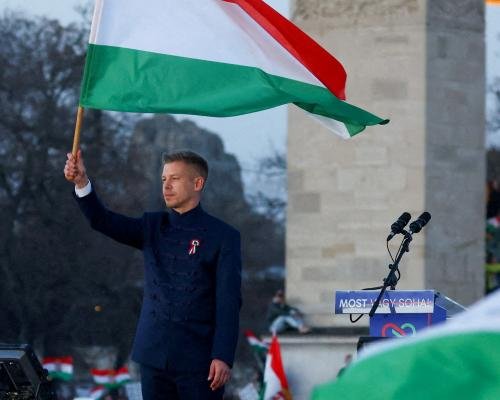
Growing up in Budapest, Péter Magyar displayed a poster of Viktor Orbán, then a prominent advocate for democracy, on his bedroom wall. Orbán was among various political icons that inspired him during the post-communist era, as he shared in a podcast interview last year. Today, at age 45, Magyar is spearheading a potential shift in Hungarian politics by aiming to unseat Orbán, whose 16-year tenure has turned the nation into a model of illiberal governance.
Magyar’s swift ascent with his Tisza party has surprised many observers. Gábor Győri from the Policy Solutions think tank in Budapest noted that no other party in Hungary’s post-communist history has gained traction so rapidly.
Opinions about Magyar vary among those familiar with him, blending respect for his organizational skills and nationwide campaigning—often delivering multiple speeches daily—with criticism of his occasionally sharp demeanor. Filmmaker Tamás Topolánszky, who documented Magyar for 18 months in a project about societal shifts in Hungary, called him genuine and driven, though sometimes impatient. Topolánszky believes these traits have energized a previously disengaged public.
Through his filming, Topolánszky observed Magyar engaging communities across rural and urban areas, breaking through widespread political indifference. The atmosphere at these events was unprecedented, he said.
Magyar’s background is deeply tied to Orbán’s Fidesz party. He associated with high-level figures, including Orbán’s chief of staff Gergely Gulyás, and in 2006 wed Judit Varga, a former Fidesz justice minister. Magyar worked as a diplomat in Brussels and in senior roles at government organizations.
His prominence surged in 2024 following revelations that Orbán’s administration, which emphasizes family values and child protection, granted a pardon to an individual involved in concealing sexual abuse at a children’s facility. This led to resignations by Varga, Magyar’s former spouse, and President Katalin Novák. Magyar publicly condemned Fidesz for shifting blame onto the women in a social media statement.
He persisted in exposing what he called a corrupt framework, portraying Fidesz as a facade that enriched elites while harming citizens. This narrative struck a chord amid rising living expenses, deteriorating public infrastructure, and unchanging wages.
After drawing around 35,000 attendees to a March 2024 demonstration, Magyar established his political group. His past Fidesz connections initially drew interest but also created hurdles. In Topolánszky’s film Spring Wind, Magyar reflected on the challenges of maintaining friendships in such circumstances.
While many supporters back Magyar and Tisza enthusiastically, some remain cautious. In Kecskemét, a resident named Anita, 33, expressed doubts but viewed voting for Tisza as a necessary risk to combat EU-leading corruption that diverts resources from essential services, exacerbating hardships for average people. She described the alternative as a gradual decline.
Topolánszky views Magyar’s insider experience as a strength, enabling him to connect with a populace wary of dissent due to the government’s influence over local affairs, media, and education. He portrays Magyar as someone who sacrificed personal ties to challenge the status quo.

