


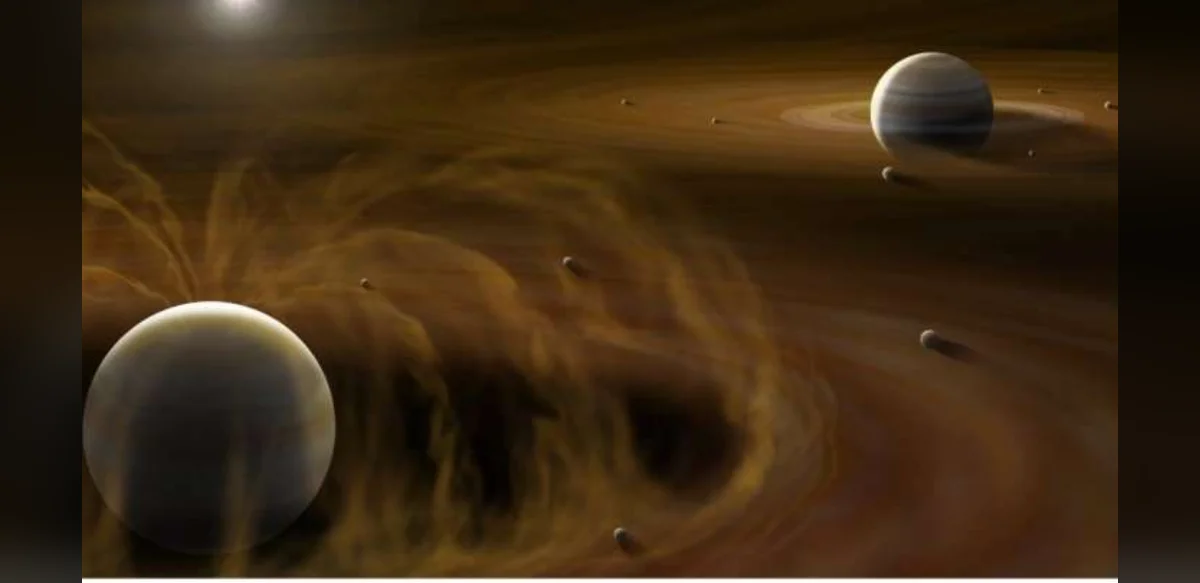
Jupiter and Saturn, the solar system’s biggest planets, each possess extensive moon systems. Yet Jupiter features four substantial moons—Io, Europa, Ganymede, and Callisto—while Saturn, despite having over 280 moons overall, claims only one major one, Titan. A recent study from Kyoto University, released in Nature Astronomy, offers an explanation for this disparity.
The key lies in the planets’ magnetic fields. During their early development, both were encircled by disks of gas and dust. Jupiter’s powerful magnetic field isolated a section of this disk, enabling the creation of multiple large moons. Saturn’s feebler field prevented such isolation, limiting it to a single prominent moon.
The research extends to gas giants elsewhere. The team’s model indicates that planets of Jupiter’s size or greater should develop compact systems with several large moons, whereas those akin to Saturn would have just one or two. This insight aids the search for exomoons orbiting planets in distant systems. As paper author Yuri Fujii explains, the moon arrangements in our solar system serve as distinctive, observable examples for testing theories of planet formation that are hard to verify elsewhere in the cosmos.

