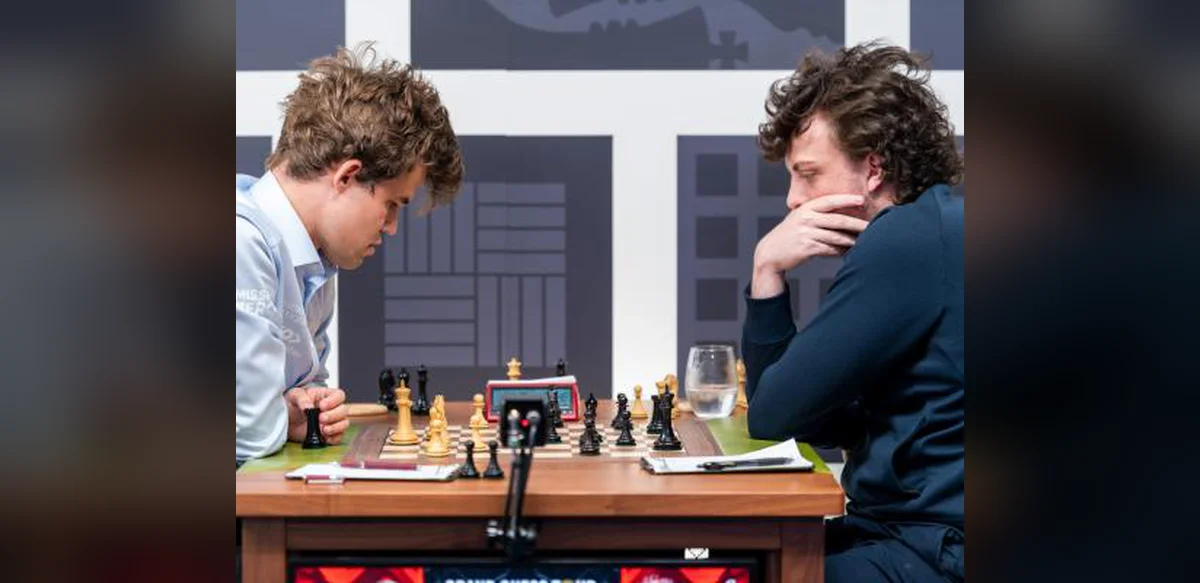
A real-life chess cheating incident involving a vibrating device in a player’s trousers occurred over 30 years ago and was recently explained. At the 1993 World Open in Philadelphia, an unrated competitor wearing fake dreadlocks and headphones, with a noticeable vibrating bulge in his pants, entered the tournament. Calling himself John von Neumann after the game theory pioneer, this unknown player drew against grandmaster Helgi Ólafsson in the second round. Ólafsson later described his opponent as clueless about chess, possibly under the influence of drugs, taking excessive time for simple moves, and behaving oddly. In the fourth round, von Neumann forfeited due to time after just nine moves, despite having two hours available. He collected some prize money but fled when organizers asked him to solve a basic chess puzzle. According to a recent book titled Lucky Devils, the player was actually a former U.S. Marine named John ‘The Duke’ Wayne, collaborating with mathematician and gambler Rob Reitzen. Their goal was to profit from games like backgammon using custom technology, testing it first in chess. Wayne relayed opponents’ moves via switches in his shoes to Reitzen in a hotel room, who used a computer to compute responses sent back through a buzzer in Wayne’s pants. However, poor signal and slow computations caused issues. The story appeared on the cover of Inside Chess magazine in 1993, dubbed the Von Neumann Affair, with a caution about computers aiding top players. This leads to a new Netflix documentary, Untold: Chess Mates, which covers the 2022 accusation against Hans Niemann for cheating after defeating world number one Magnus Carlsen. Carlsen withdrew from the Sinquefield Cup and posted a cryptic message online implying trouble if he spoke out. Niemann admitted to online cheating at ages 12 and 16 but denied using a vibrating sex toy to receive signals against Carlsen. The anal beads rumor became a joke, and Niemann faced heavy criticism. He was later cleared of over-the-board cheating in that game, but tensions persist. The documentary highlights no new revelations but warns about risks when money is involved, rules are weak, and trust breaks down. Chess.com’s CEO Erik Allebest noted boosts from events like the pandemic and The Queen’s Gambit, jokingly adding that the anal beads scandal helped, then retracting it with laughter. Chess.com knew of Niemann’s past online cheating but stayed silent until approached by Carlsen’s father after the loss, which raised questions. Amid rapid growth to six million daily users and a near-billion-dollar valuation, the company showed a startup-like approach. Niemann’s case is complex; he has insulted rivals, damaged hotel property, and aspired to emulate the controversial former champion Bobby Fischer. He acknowledges not being likable and is a talented player with a cheating history. Opinions in chess circles vary on whether youthful mistakes should linger, with some distrusting him and others praising his perseverance amid public ridicule at age 19. Carlsen criticizes Chess.com for misleading him about evidence against Niemann in physical games. From the 1993 incident to the 2022 controversy, chess has evolved. Back then, amateurs cheating was surprising, and top humans like Garry Kasparov outmatched computers. Today, the