


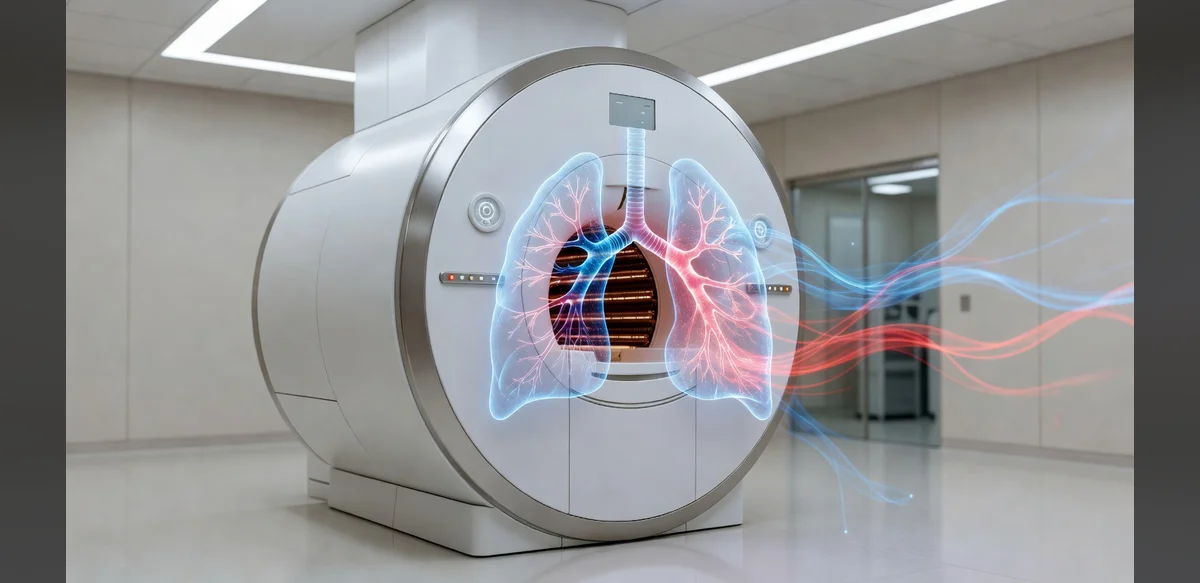
Children face greater risks from radiation exposure compared to adults, prompting the need for safer diagnostic options.
Key Points:
– Innovative MRI with hyperpolarized Xenon-129 gas provides lung imaging without radiation.
– This method evaluates lung ventilation, perfusion, and gas exchange, surpassing standard imaging.
– It enables early identification of lung issues in children prior to symptom escalation.
Physicians typically use CT scans to diagnose pediatric lung disorders, but these involve radiation, which experts aim to limit in young patients. Recent studies suggest a safer option that could transform early detection of uncommon lung problems. A report in the European Journal of Radiology notes that conventional MRIs have difficulty imaging lungs due to their air-filled nature, which yields weak signals. The new approach employs hyperpolarized Xenon-129 gas for radiation-free results.
These advanced MRIs examine lungs using magnetic fields and radio waves, avoiding ionizing radiation. This is especially beneficial for children, who are more susceptible to radiation effects and might need multiple scans.
How This Method Stands Out
Standard MRI has faced challenges with lungs because of their air content and motion. However, modern techniques like functional lung MRI and hyperpolarized gas imaging now enable assessment of lung function alongside structure. These can chart:
– Ventilation patterns
– Blood circulation
– Gas transfer effectiveness
Such details were previously hard to obtain without radiation.
Identifying Uncommon and Initial Lung Issues
A major benefit of these non-radiative scans is spotting lung problems early, before they intensify. Studies indicate that advanced MRI can reveal issues in children with disorders such as cystic fibrosis or severe asthma, often ahead of traditional tests. Early detection can:
– Enhance treatment results
– Delay disease advancement
– Minimize future issues
In certain instances, MRI delivers both anatomical and operational data in one session.
Importance of Avoiding Radiation in Pediatrics
Young patients are more affected by radiation, with risks rising from repeated doses. One CT scan can deliver radiation comparable to many chest X-rays. Consequently, specialists are turning to MRI for safer, ongoing monitoring of chronic or rare lung issues.
Will MRI Fully Supplant CT Scans?
Although MRI technology is advancing quickly, CT scans excel at capturing minute lung details like small nodules or early tissue changes.
Still, professionals anticipate MRI could handle many CT roles, particularly for routine checks, greatly cutting radiation in children.
Implications for Families
For parents of children needing frequent lung imaging, this progress brings comfort. Clinicians may opt for MRI when suitable, weighing precision against safety. Scan selection depends on:
– The specific lung condition
– Symptom intensity
– Physician’s evaluation
Advanced MRI techniques for radiation-free lung imaging represent a valuable advancement in child healthcare. They offer a secure means to identify and track rare lung disorders without ongoing radiation risks. While not yet a full substitute for CT, this innovation advances diagnostic safety and sophistication. Ongoing studies may influence future approaches to diagnosing and treating pediatric lung conditions.

