


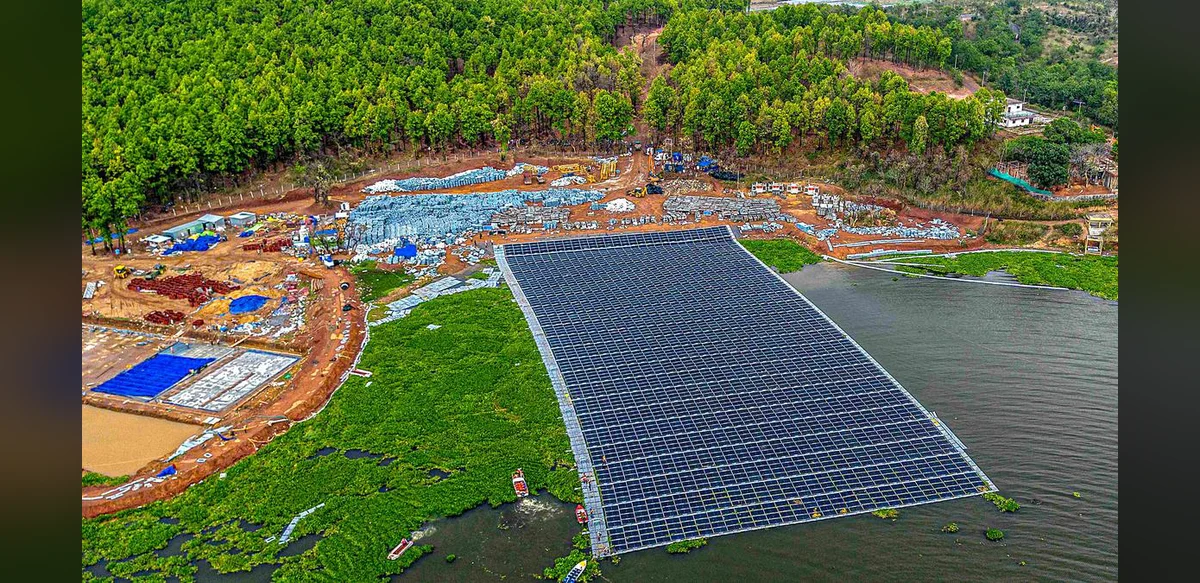
India’s reservoirs could support around 102 gigawatts of floating solar capacity, according to the first nationwide evaluation by the National Institute of Solar Energy, an autonomous body under the Ministry of New and Renewable Energy. The study presents floating panels as a solution to land scarcity, a persistent challenge for solar development.
The 121-page report offers no India-specific cost projections. It references a 2021 U.S. National Renewable Energy Laboratory benchmark noting that floating installations typically require about 25 percent higher initial investment than ground-mounted systems because of floats, anchoring, and waterproofing.
MNRE Secretary Santosh Kumar Sarangi stated at the report launch that discussions with the Finance Ministry are ongoing to advance floating solar and agri-photovoltaics, which combine farming with elevated solar structures.
Ground-mounted solar, which accounts for most of India’s roughly 100 GW installed capacity, needs three to four times the area occupied by the panels themselves. Land acquisition remains expensive, slow, and often contentious with farming and residential needs, hindering the 500 GW non-fossil target by 2030. The report describes floating solar as land neutral.
NISE applied six geospatial filters to inland water bodies: lakes and reservoirs over 10 hectares, water availability for at least 11 months yearly, depths of 3 to 30 metres, solar irradiance above 4.5 kWh per square metre per day, and location within 10 km of roads and substations.
Testing on Odisha’s Hirakud reservoir reduced 499 square kilometres to 99.5 square kilometres of usable area. Nationwide application produced 1,946 square kilometres of feasible surface, with a 20 percent cap per reservoir, equating to 102.18 GW. Maharashtra leads with 16.28 GW, followed by Madhya Pradesh at 14.89 GW, Karnataka at 13.69 GW, Odisha at 12.81 GW, and Telangana at 10.72 GW.
The Omkareshwar floating solar park on the Narmada river in Madhya Pradesh, currently 278 MW and planned to reach 600 MW, is India’s largest. Field checks there noted loosening float joints, misaligned platforms, and uneven buoyancy, plus developer reports of cable failures.
Global floating solar capacity reached about 9.6 GW by 2024, with nearly 90 percent in Asia. China dominates, including a 120 MW installation on a fish farm. Singapore’s 1 MW testbed has provided key performance data, while the Netherlands holds roughly three-fourths of Europe’s capacity, mostly on quarry lakes.

