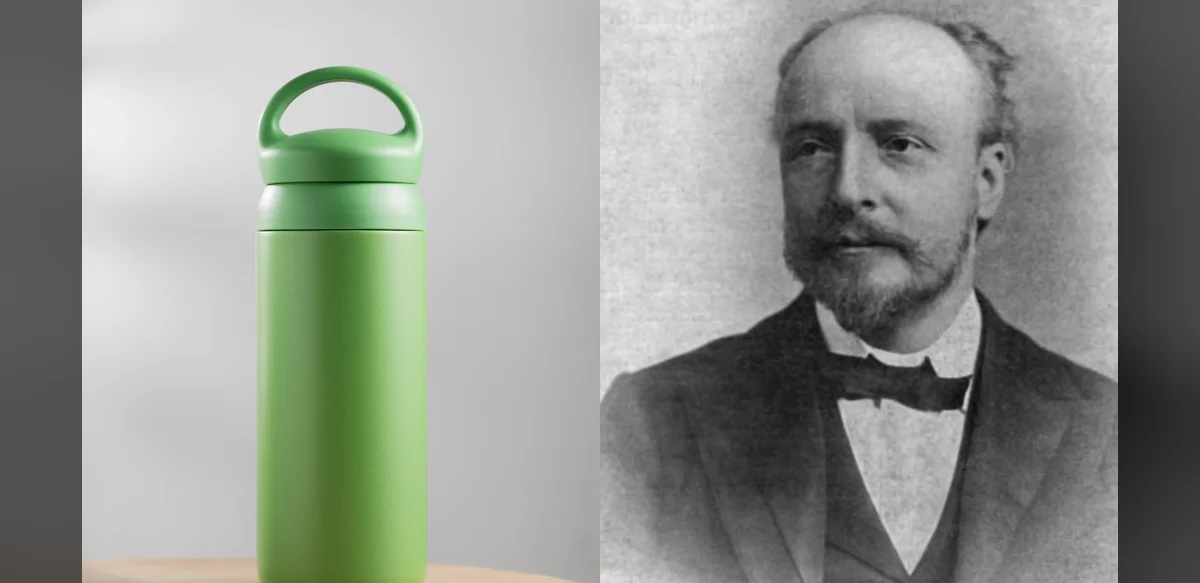
The scientific challenge that prompted James Dewar to create the vacuum flask explains why this device became the basis for every modern thermos. It also shows how the thermos turned into a worldwide household staple. Most view a thermos as a basic item for keeping tea warm or water cool. Its roots trace instead to demanding nineteenth-century research on extremely low temperatures. In 1892 Scottish chemist and physicist Sir James Dewar sought a container that could hold liquefied gases long enough for study. These materials quickly absorbed surrounding heat and turned to gas. Dewar created a double-walled vessel with a vacuum between the walls to limit heat transfer. The laboratory device for cryogenic work later became a familiar consumer product. Dewar never patented the design, so others could adapt it commercially. In the late nineteenth century scientists competed to understand matter at very low temperatures. Dewar concentrated on liquefied oxygen and hydrogen, which needed special containers to stay stable. The vessel consisted of one glass flask inside another with a partial vacuum between them. The vacuum cut heat movement by conduction and convection, while silvered surfaces reduced radiation. This allowed liquefied gases to stay cold much longer. The flask was built to maintain substances at very low temperatures. It was first shown publicly at the Royal Institution on Christmas Day 1892. Heat normally moves by conduction, convection and radiation. Removing most air between the walls and adding reflective surfaces blocked all three routes. The evacuated space acted as a near nonconductor of heat, so both hot and cold contents kept their temperatures for long periods. Although meant for cryogenic liquids, the same design worked equally well for retaining heat. By 1898 stronger versions were already produced for sale. Dewar did not patent the flask. Early in the twentieth century German glassblowers Reinhold Burger and Albert Aschenbrenner saw its everyday uses. They added a metal casing and obtained patents for household versions. The item was sold under the name Thermos, from the Greek word for heat. Dewar’s invention was later patented for industrial production in 1904. More than a century afterward the basic design remains the same. Modern insulated bottles, food containers, laboratory cryogenic vessels and medical storage units still use the vacuum-insulation method introduced in the 1890s.