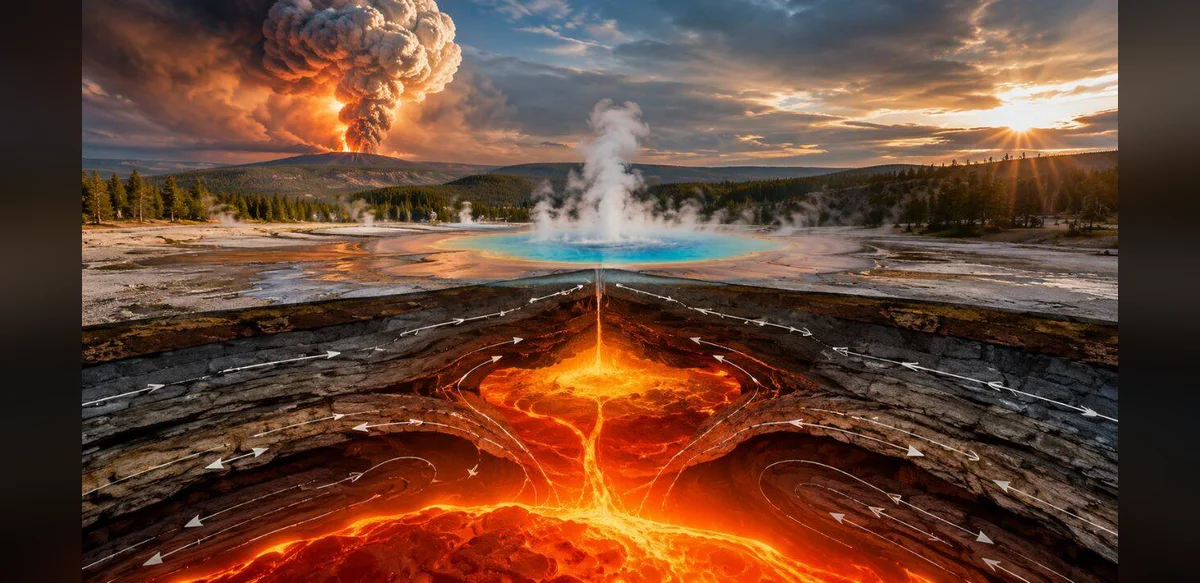
Yellowstone National Park lies over one of Earth’s largest active volcanic systems. Below its surface sits an extensive network of molten rock that has triggered three massive eruptions in the past 2.1 million years. The most recent, about 631,000 years ago, formed the current caldera roughly 50 kilometres wide. For years, many scientists viewed the volcano as powered mainly by a deep mantle plume of hot material rising from Earth’s interior. A recent study in Science challenges this view. Researchers created a three-dimensional model simulating millions of years of geological shifts across western North America. The model incorporated data on ancient plate motions, current mantle structure, and properties of the lithosphere. Results indicate that movements in the crust and upper mantle, driven by varying rock densities and the sinking remnants of the ancient Farallon plate, may generate enough stress to sustain the magma supply. These forces gradually open pathways for molten material to reach the surface without needing a classic plume. The findings align with earlier observations showing magma originating southwest of the caldera and moving northeast. Experts note the study adds useful context but agree that Yellowstone’s deeper structure requires further investigation.