


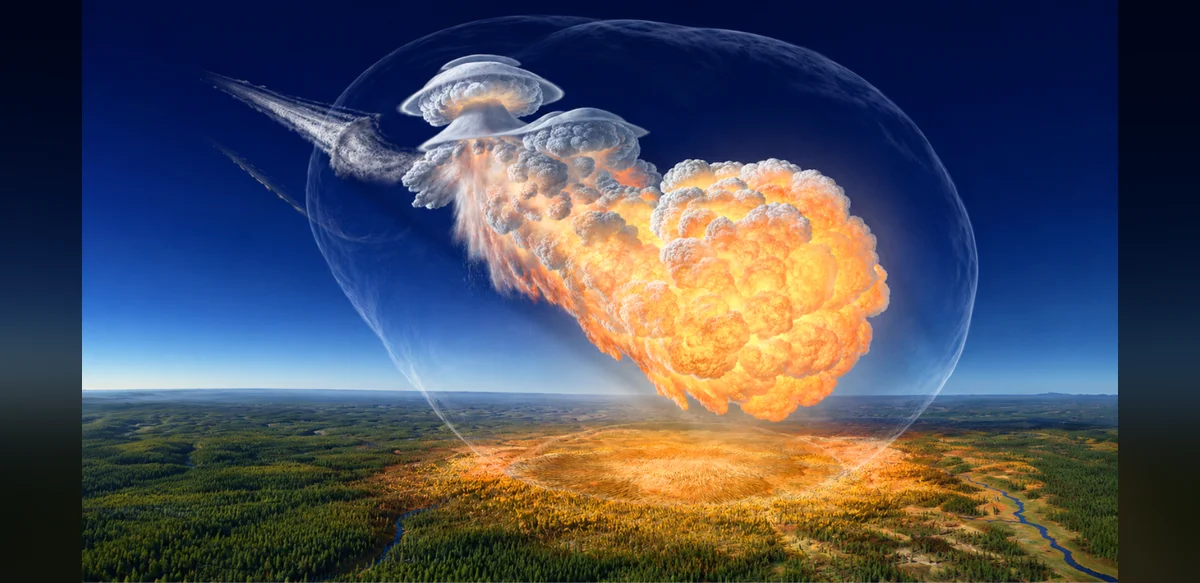
An explosion powerful enough to destroy millions of trees should have left a giant crater. Instead, researchers who reached the remote Siberian site found only flattened forest with no impact hole or meteorite fragments. More than a century later, the Tunguska event remains the largest recorded impact in human history and one of science’s enduring mysteries. It released an estimated 10 to 15 megatons of energy, hundreds of times stronger than the Hiroshima bomb, and altered both the landscape and awareness of space hazards.
When Soviet mineralogist Leonid Kulik arrived in 1927, nearly 20 years after the blast, he expected to find a large meteorite. What he discovered was a vast area of about 2,150 square kilometres where roughly 80 million trees had been knocked down. No crater existed. Trees near the centre stood upright but stripped of branches, while those farther out lay pointing away from the blast point. Kulik described the scene as if a giant had mowed the forest with a scythe. His images later became key evidence that the detonation happened in the air.
On 30 June 1908, witnesses across central Siberia saw a bright object cross the sky, followed by powerful explosions. One observer 65 kilometres away said the sky split open and a wave of heat knocked him down. Shockwaves shattered windows hundreds of kilometres distant and registered on seismic instruments across Eurasia. Because the site lay in an isolated region, news spread slowly and no full investigation occurred until the late 1920s.

