


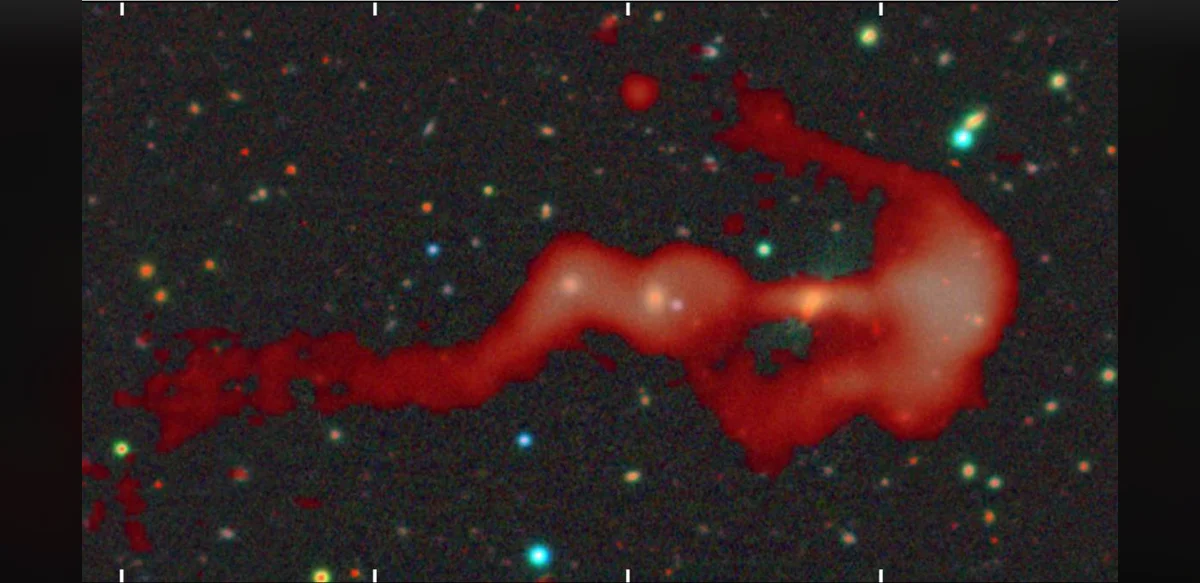
Twelve Indian researchers working across three countries have identified a rare radio galaxy with an unusual bow-and-arrow shape. The structure spans 1.8 million light years and lies roughly two billion light years from Earth. A light year equals about 5.88 trillion miles. Radio galaxies are active systems powered by supermassive black holes that release large amounts of energy as radio waves.
The object has been named RAD-BAARG. RAD refers to RAD@home Astronomy Collaboratory, India’s first citizen-science astronomy platform located in Kharghar, Navi Mumbai. BAARG stands for Bow And Arrow Radio Galaxy. The team’s findings appeared June 22 in Monthly Notices of the Royal Astronomical Society. The paper describes the asymmetric structure as unlike typical radio galaxies.
A kiloparsec equals 1,000 parsecs or roughly 3,260 light years. Lead author Ananda Hota of the University of Mumbai founded RAD@home thirteen years ago to let students and others conduct extragalactic research from home. Co-authors include Pratik Dabhade of Poland’s National Centre for Nuclear Research, Shubhrangshu Ghosh of Sikkim’s SRM University, Mitali Damle of New York University Abu Dhabi, and several researchers from institutions in West Bengal, Noida, and Poland.
The discovery used sensitive images from the LOFAR Two-metre Sky Survey. It follows the group’s earlier 2025 detection of a distant Odd Radio Circle. One jet from the central black hole appears to interact with a bow-shock structure created as the host galaxy falls through hot gas toward a nearby cluster.
Mr. Ghosh explained that galaxies moving faster than the speed of sound in the surrounding medium can compress gas and form large shock fronts. The radio plasma from RAD-BAARG makes this faint feature visible. The western side shows a narrow jet feeding an arc-like structure nearly 560 kiloparsecs long, while the eastern side displays a distorted S-shape extending almost 600 kiloparsecs.
The host galaxy sits in a complex environment with multiple cluster-scale systems at similar distances. The morphology indicates interaction between the jets and large-scale gas motions and possible shocks linked to the galaxy’s infall. Although models have predicted such bow shocks, direct detection has been difficult because the gas is faint. RAD-BAARG offers a clear radio view of the process.
Mr. Hota noted the source’s unusual shape after twenty-five years of observation. Mr. Dabhade highlighted its location in a multi-halo setting where gas flows and shocks reshape the plasma.

