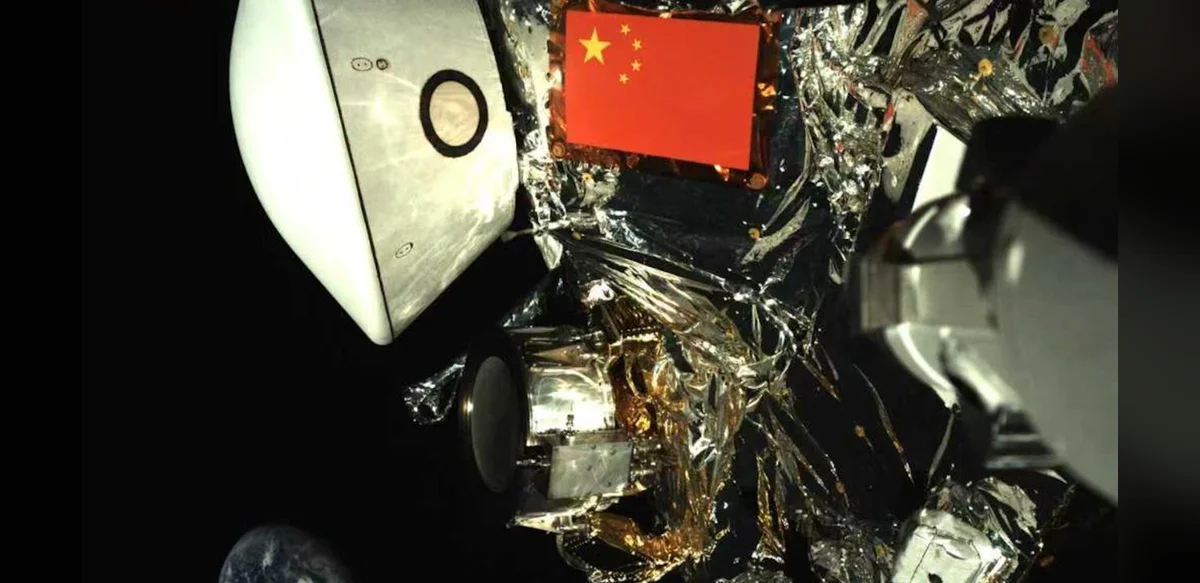
Earth shares its solar orbit with several small asteroids known as quasi-moons. These objects complete one circuit around the Sun in roughly a year, much like our planet. Eight such bodies are currently known. One of them, asteroid 469219 Kamo’oalewa, may be a fragment of the Moon. Roughly 30 to 60 metres wide, it maintains a stable path that closely matches Earth’s. Scientists suspect it could be lunar material blasted into space by an ancient impact, though recent spectral data also point to a common stony asteroid altered by space weathering. To resolve the question, China’s Tianwen-2 mission, launched in May 2025, is approaching the asteroid to collect samples. The probe has already performed engine burns and is expected to enter orbit in early July. It will attempt several collection methods, including hovering to gather dust, touching down for larger rocks, and probing beneath the surface. Quasi-satellites remain bound to the Sun rather than Earth, yet they can appear to circle our planet for centuries. Kamo’oalewa entered its present orbit about a century ago and will stay in step with Earth for a long period. Samples returned to Earth should reveal mineral and isotopic details impossible to obtain from ground-based telescopes alone. Earlier missions to other asteroids have shown how laboratory analysis can uncover origins hidden by surface weathering.