

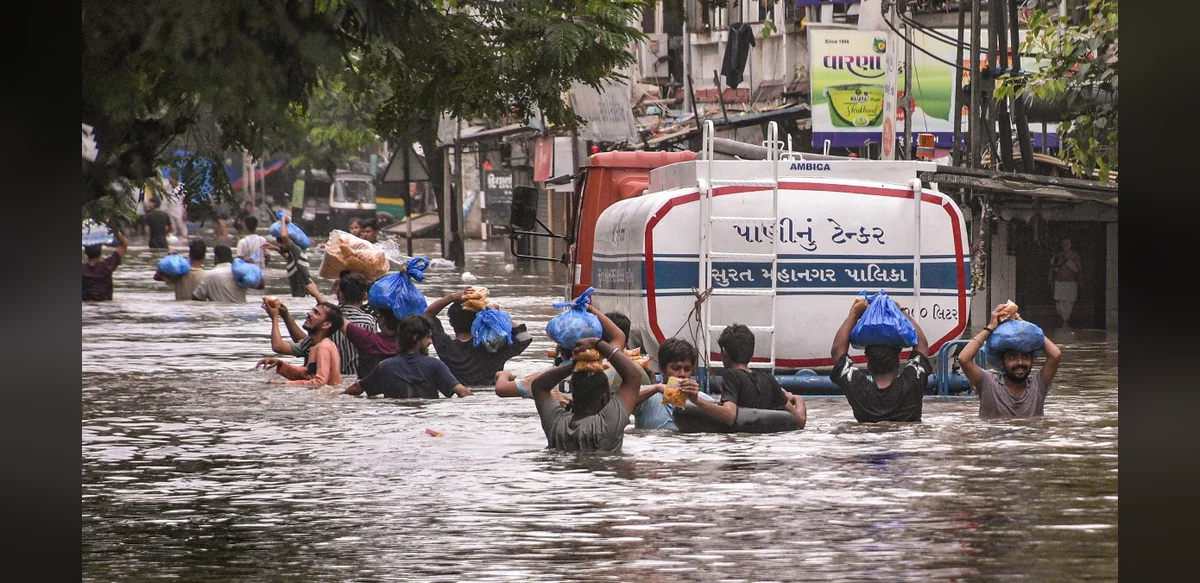
Torrential monsoon rains struck large areas of India on Wednesday and Thursday, triggering flash floods, landslides, a building collapse and widespread disruption to road and rail traffic in multiple states. Rescue teams operated in several locations, thousands of people were evacuated from flood zones, and the India Meteorological Department forecast additional heavy rainfall in various regions.
Union Home Minister Amit Shah contacted the chief ministers of Kerala, Maharashtra, Gujarat and Jammu and Kashmir to assess conditions and stated that the central government would provide all necessary support. Effects were reported in Delhi-NCR, Maharashtra, Gujarat, Kerala, Jammu and Kashmir and Rajasthan, with officials maintaining vigilance as the monsoon intensified.
Delhi-NCR recorded one of its heaviest rain events of the season overnight, causing waterlogging in numerous neighbourhoods and slowing traffic throughout the city. The IMD issued red and orange alerts for thunderstorms, intense precipitation and lightning. Rainfall totals by 8.30 am included 102 mm at Mayur Vihar, 83 mm at Pusa, 80 mm at Lodhi Road and 72.6 mm at Safdarjung over the prior 24 hours.
Three people died in Rohini when a newly constructed four-storey building collapsed. A civic assessment indicated ongoing plumbing work and possible cutting of structural elements such as beams and columns may have caused the failure. Authorities have not connected the incident to rainfall.
Severe waterlogging occurred in areas including Sadar Bazar, Nasirpur, Greater Kailash, Badarpur, Teliwara, Mahavir Bazar, Swarup Nagar and Kushak Road. Traffic moved slowly on Ring Road, Outer Ring Road and NH-48, particularly near Dhaula Kuan, Mahipalpur and Rajokri.
The Delhi Fire Service responded to reports of uprooted trees in East of Kailash, while civic bodies handled complaints about waterlogging, fallen trees and power outages. The Delhi government noted that chronic flooding spots such as Minto Bridge and ITO remained clear.
Neighbouring Gurugram also faced waterlogging that stranded vehicles and reduced traffic speeds on major routes, including the Delhi-Jaipur Highway service lane near Narsinghpur, Basai, Umang Bhardwaj Chowk, Kadipur, Sector 10A and Sohna Road.
In Maharashtra, rescue efforts continued in Pimpri Chinchwad after a large garbage mound collapsed following heavy rain, with 11 people feared trapped. Mumbai experienced renewed heavy showers and thunderstorms that delayed suburban trains and affected commuters.
Long-distance trains to Gujarat remained disrupted due to waterlogging in the Vasai-Virar section and parts of south Gujarat. Mumbai-Pune services were also impacted by landslides in the Bhor Ghat area.
Gujarat’s Surat faced severe strain from torrential rain and flooding. Officials reported at least nine deaths in rain-related incidents over recent days. Thousands of residents from low-lying areas were moved to safer locations, and food packets were distributed to those stranded in inundated high-rise buildings. Many parts of the city stayed flooded.
In Kerala’s Wayanad district, searches continued for five missing persons after a rain-soaked mound of excavated earth collapsed at a tunnel project site. Chief Minister V D Satheesan visited to review operations hampered by intermittent rain.
In Jammu and Kashmir, heavy rain caused flash floods in parts of Doda district, prompting emergency measures. The situation was discussed by Amit Shah with the chief minister.
In Rajasthan, the southwest monsoon stayed active, with Ramganj Mandi in Kota district recording the state’s highest rainfall at 10 cm. The IMD forecast further rain in several districts over the next two to three days, raising risks of additional flooding. With the monsoon strengthening across northern, western and southern India, authorities continued close monitoring amid forecasts of more heavy rainfall.


