


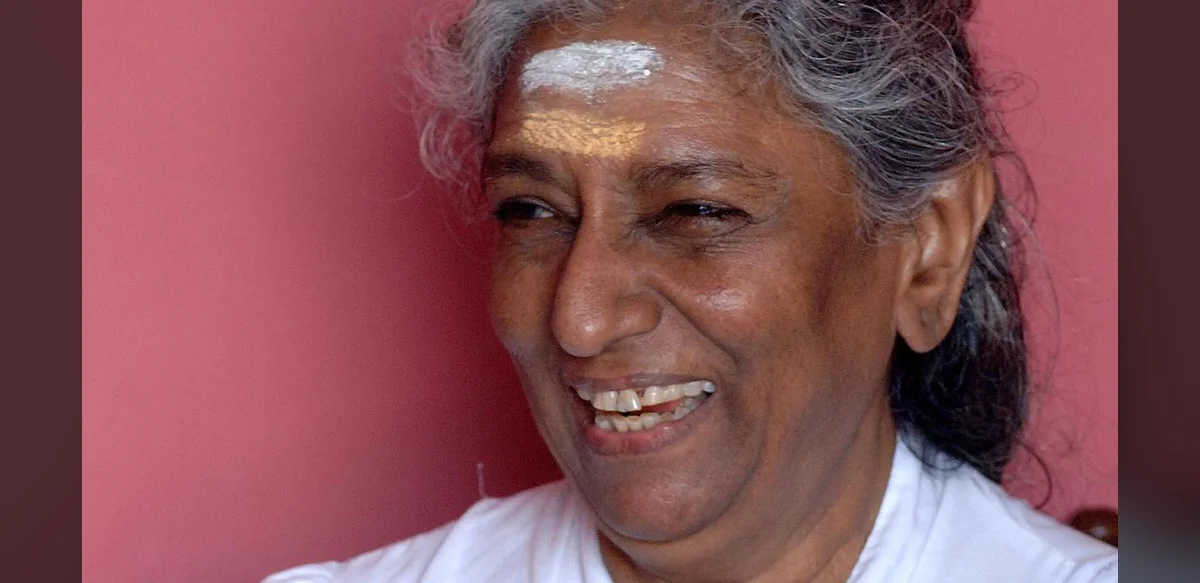
S. Janaki entered Bollywood’s spotlight in 1985 through Bappi Lahiri’s track ‘Yaar Bina Chain Kahan Re’ from Saheb. Her classical precision blended with the energetic beat of Bombay disco. The opening line, delivered in her distinctive sweet and slightly nasal tone, stood out from other singers of the period. The song, featuring Anil Kapoor and Amrita Singh, aired frequently on television shows and became a staple at weddings, festivals, and public transport across northern India.
Around the same period, she paired with Kishore Kumar on ‘Rock N Roll’ and ‘Bol Baby Bol’ from Meri Jung. Composed by Laxmikant-Pyarelal, these tracks featured bold brass and syncopated rhythms suited for dance floors. Janaki’s timing showed she could lead the beat rather than follow it.
Her range appeared again when K. Viswanath adapted Sankarabharanam into Sur Sangam. Laxmikant-Pyarelal kept her voice for the Hindi version. She handled complex classical passages in ‘Prabhu More Avagun Chit Na Dharo’ alongside Anup Jalota, proving command over traditional Hindustani music.
Observers note that the arrival of South Indian producers in Bollywood during the 1980s helped position Janaki as a national-level singer. Her clear pronunciation and wide range let her move between classical pieces and upbeat numbers. Lahiri reportedly discovered her while she recorded a Tamil song at a studio.
She worked with Lahiri and Laxmikant-Pyarelal on commercial films yet also recorded for O.P. Nayyar and Salil Chowdhury. The latter valued her accurate Hindi and Urdu diction. For Chowdhury she adapted a Malayalam melody into ‘Chhalke Sanjh Ke Naina’ and the duet ‘Mere Prem Ki Ragini’ with S. Yesudas.
She accepted R.D. Burman’s request for the street-style ‘Bataata Vada’ in Hifazat and later sang ‘Tere Pyaar Main Hum’ with S.P. Balasubrahmanyam for Jamai Raja. In Aakhree Raasta she performed both the romantic ‘Gori Ka Saajan’ with Kishore Kumar and the maternal ‘Toone Mera Doodh Piya Hai’ with Mohammed Aziz.
Her emotional depth is captured in the solo ‘Dil Mein Ho Tum’ from Satyamev Jayate, a haunting melody that continues to resonate.

