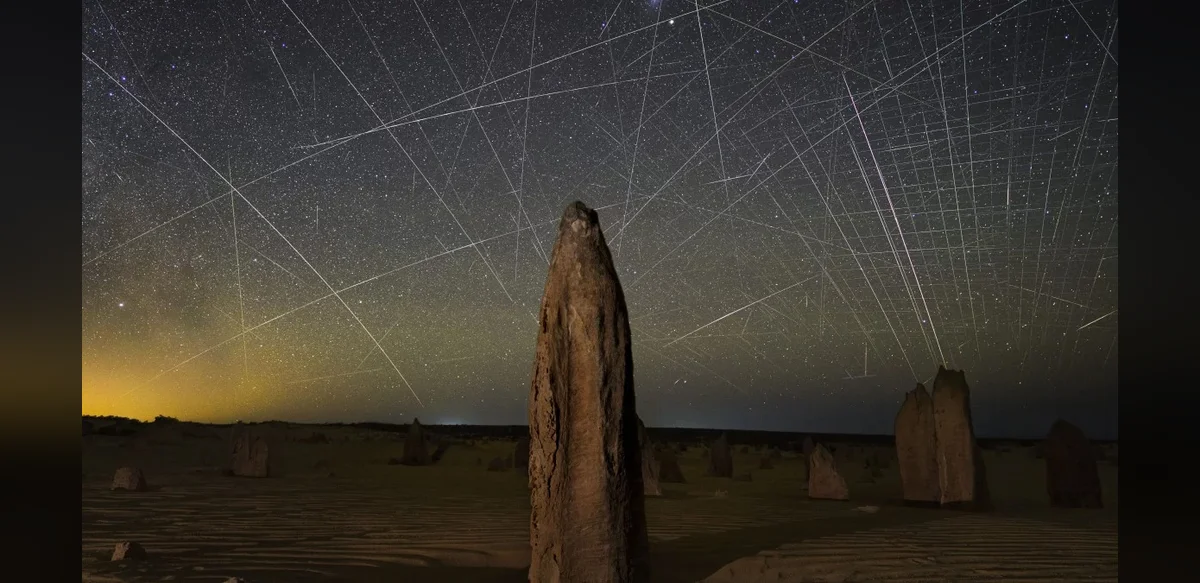
Low Earth orbit now holds more than 14,000 satellites, a figure rising rapidly and creating growing light pollution that affects ground-based astronomy. This interference already disrupts many observatory images, and planned additions will worsen the issue. Astrophysicist Astha Chaturvedi of the University of Surrey notes that the night sky, a key window on the Universe, is becoming harder to observe. Researchers propose using Vantablack 310, a durable ultra-black coating, on spacecraft. Laboratory tests showed it reflects only two percent of incoming light. Models indicated that coated satellites would register between 6.7 and 7.8 on the AB magnitude scale, fainter than uncoated objects and comparable to or better than prior SpaceX mitigation efforts. Electron microscopy revealed coral-like surface structures that trap light. The coating requires further space testing, yet it is scheduled for the Jovian-1 CubeSat mission to gather real orbital data. The study appears in Monthly Notices of the Royal Astronomical Society.