


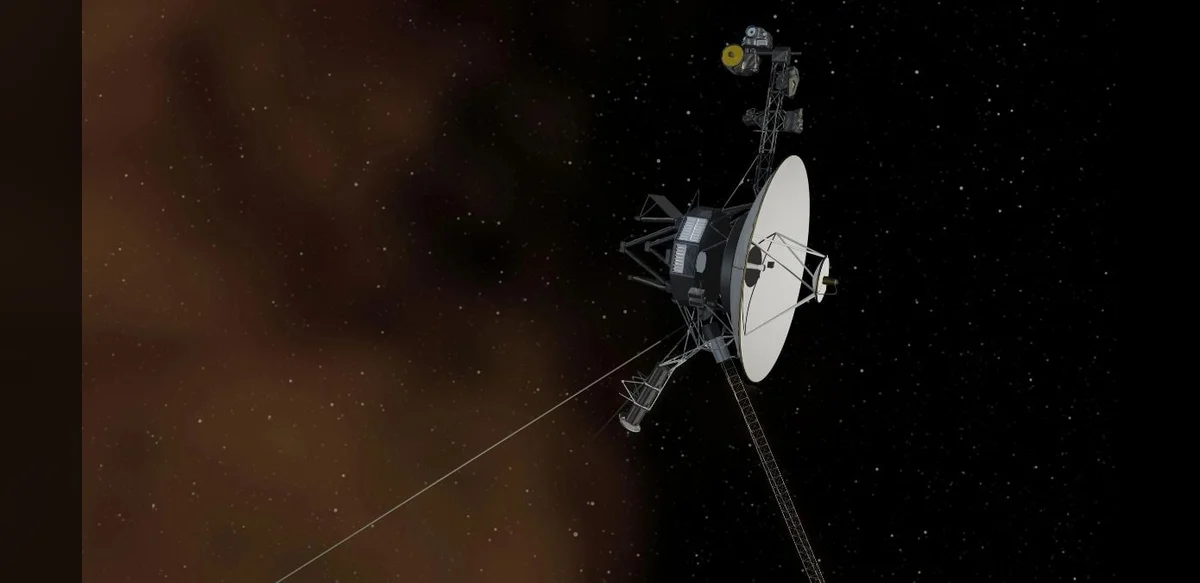
Voyager 1 has followed an extraordinary path that exceeded initial plans. The compact probe became the first human-made object to reach interstellar space and has continued traveling away from Earth at 61,100 kilometers per hour for nearly five decades.
It has not yet covered one light-day of distance, but NASA has determined the exact time this will occur. On 18 November 2026 at 2:16 AM PST, the spacecraft will be 25.9 billion kilometers from Earth, matching the distance light travels in one day.
This milestone adds to the mission’s record of firsts. Voyager 1 and its twin are the only probes operating beyond the heliosphere, the Sun’s protective bubble of particles and magnetic fields.
The distance also influences communication delays. Commands sent from Earth now take roughly two days for a response.
Originally tasked with flybys of Jupiter and Saturn in 1979 and 1980, the spacecraft kept operating. It and its twin returned data from the outer planets and continue to study conditions in interstellar space.
Power from the plutonium source is declining. NASA has deactivated instruments to extend operations, leaving only the magnetometer and plasma wave subsystem active.
Contact is expected to continue into the early 2030s. Both Voyagers carry gold-plated records with sounds, images, and greetings from Earth, intended as a message for any future finders.

