


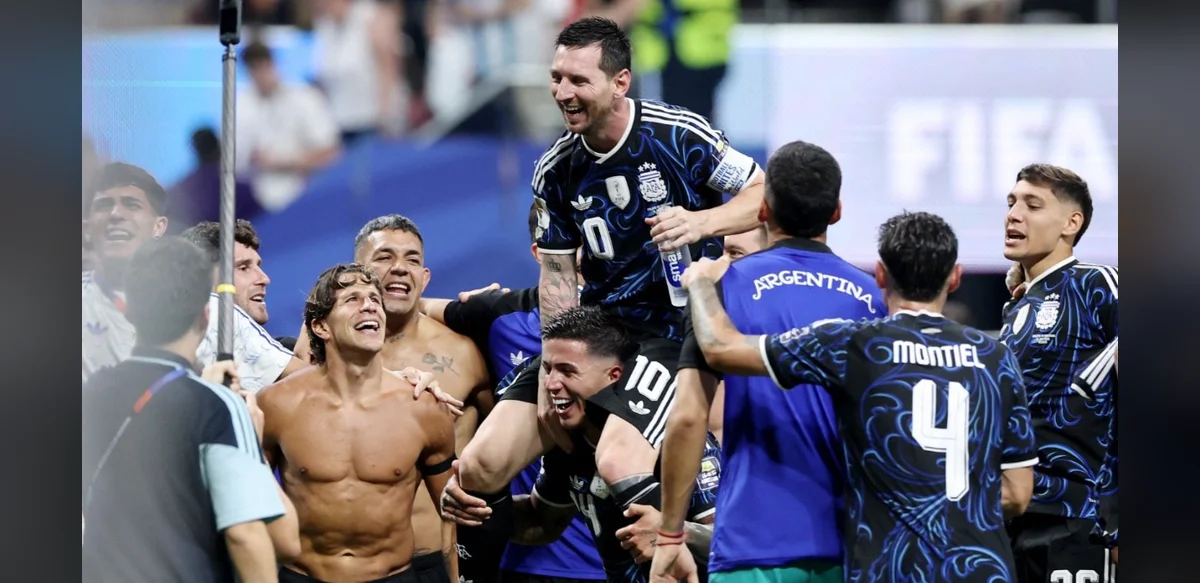
England believed they had controlled the contest. Lionel Messi had been contained, Thomas Tuchel’s strategy appeared effective, and Anthony Gordon’s second-half goal placed the team close to a first World Cup final since 1966.
Defending champions rarely require extra incentive. They complete the task through various methods.
The title holders achieved this as Messi organized from deeper positions instead of focusing on scoring. Argentina’s other players rose to the occasion, reversing the semi-final to secure a 2-1 victory in Atlanta on July 16. The result advanced Lionel Scaloni’s team to a consecutive World Cup final and sustained hopes of becoming the first nation since Brazil in 1962 to retain the trophy.
For over an hour England restricted the holders. They limited Messi’s movement, broke Argentina’s flow, and seemed ready to end the champions’ run. Yet when England held back rather than seeking a second goal, Argentina identified an opening. They remained composed, followed their approach, and with Messi guiding from midfield produced another demonstration that champions succeed through skill and firm conviction.
England’s approach succeeded in restricting Messi for long periods. Tuchel’s plan involved close marking whenever Messi moved into midfield. Declan Rice protected the defense well, Jude Bellingham maintained pressure, and Elliot Anderson’s movement limited the captain’s usual space.
Argentina held most of the ball but struggled to create clear chances. Julian Alvarez had little room, and Messi dropped deeper to participate. England threatened on breaks, with Morgan Rogers advancing the ball, Harry Kane connecting play, and Gordon stretching the defense.
Gordon scored ten minutes into the second half after a precise pass from Rogers, giving England the lead. At that stage the team occupied the position it sought.
England then gradually yielded control instead of pursuing another goal. Their pressing eased, the defensive line moved back, and possession turned defensive. Against Argentina’s standard this change proved costly.
Scaloni’s side stayed patient after conceding and maintained their established methods. Argentina waited for the next opening. England’s caution allowed sustained pressure, which the holders used. De Paul controlled possession, Mac Allister found space, and Alvarez tested the defense further.
Messi no longer relies on constant dribbling or goals at age 39. He influences games through positioning, timing, and choices. Each action changed the tempo and created openings for teammates. Enzo Fernandez equalized with a well-timed run, and Lautaro Martinez scored the winner seven minutes later after another Messi pass. Messi recorded two assists, yet Argentina demonstrated they no longer depend solely on his individual actions.

