

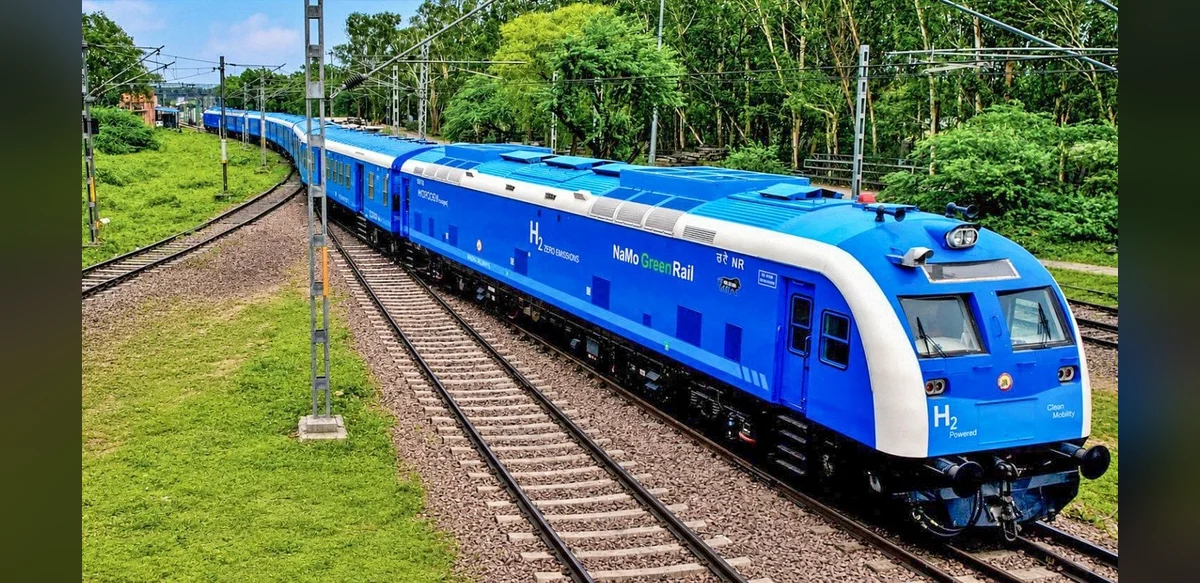
India entered a new phase of clean rail transport on Friday when Prime Minister Narendra Modi inaugurated the nation’s first domestically developed hydrogen fuel cell train. This makes India one of the few countries using hydrogen technology for railway operations.
The train will run on the Jind-Sonipat section of Northern Railway as a pilot project to test hydrogen-powered mobility on one of the world’s largest rail systems.
With this launch, India joins nations including Germany, Japan, China and the United States in developing hydrogen rail transport. The train produces its own electricity onboard through hydrogen fuel cells.
HOW THE HYDROGEN TRAIN OPERATES
Unlike diesel locomotives, the hydrogen train creates electricity onboard using hydrogen fuel cells. A 1,200-kilowatt Proton Exchange Membrane Fuel Cell converts hydrogen and oxygen into electricity. The only outputs are water vapour and heat.
Compressed hydrogen is stored in high-pressure cylinders in two Hydrogen Driving Power Cars. The fuel cell functions like a battery that requires no recharging while hydrogen is available. Hydrogen molecules split into protons and electrons via a platinum catalyst. Electrons generate electricity to power traction motors.
Oxygen from air combines with protons and electrons, producing only water vapour and heat with no combustion or carbon emissions at the point of use.
Electricity is also stored in Lithium Iron Phosphate batteries for acceleration and regenerative braking, improving efficiency and cutting hydrogen use.
Hydrogen has an energy density of about 120 megajoules per kilogram versus 43 MJ/kg for diesel. The system offers lower maintenance and reduced environmental impact.
India’s largest railway hydrogen storage and refuelling facility at Jind in Haryana supports operations. It stores nearly 3,000 kilograms of hydrogen and meets international safety standards.
The train was developed entirely in India under the Research, Design & Standards Organisation. The 10-coach train includes two power cars and eight trailers, carrying up to 2,600 passengers at a maximum speed of 75 kmph.
The service links Jind Junction, Gohana Junction and Sonipat. Safety features include leak detectors, flame sensors, ventilation, automatic shut-off and real-time monitoring. The pilot will provide data for wider hydrogen train deployment.


