


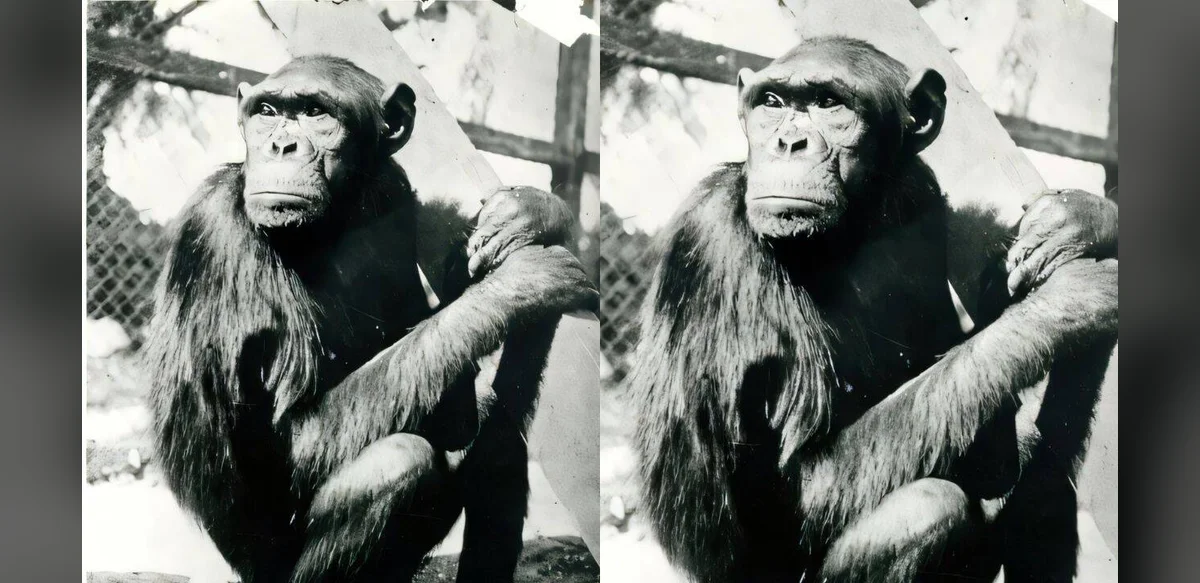
More than a century ago, a small group of chimpanzees helped transform scientific views on intelligence. In experiments on Tenerife, the apes showed they could solve problems through sudden insight instead of only trial and error. This challenged ideas about human reasoning being unique.
Their scientific contributions gained wide recognition, yet the animals’ own later lives received little notice. Archival records now detail what occurred after the group moved to Berlin, as described in a study published in European Psychologist.
The Prussian Academy of Sciences opened its research station on Tenerife in 1913. Psychologist Wolfgang Köhler directed it from 1914 to 1920 and conducted the key tests with chimpanzees including Sultan, Rana, Chica, Grande, Tercera and Tschego. He gave them novel tasks that called for planning rather than repeated rewards.
In one test, bananas hung out of reach with crates nearby. Some chimpanzees stacked the boxes to form a platform and climbed to the fruit. In another, Sultan joined two short sticks to reach food beyond arm’s length. These actions appeared to reflect sudden understanding.
The work became a landmark in comparative psychology and showed chimpanzees have advanced cognitive skills.
When the station closed in the 1920s, the six surviving chimpanzees went to Berlin Zoo. Little was known about their time there until recent analysis of zoo records and correspondence.
The animals, originally from Cameroon forests, faced Berlin’s cold winters. Postwar financial strain led to poor heating and a diet of bread and potatoes rather than fruit. Illness, births and group tensions added to the difficulties, contributing to early deaths.
Preserved remains of several chimpanzees were later identified at Berlin’s natural history museum. DNA study of these specimens could clarify their origins.
The chimpanzees lived through the economic troubles of the interwar years, which worsened conditions at the zoo. Their welfare declined until they vanished from records one by one.
Researchers note that recalling the animals’ experiences matters as much as their scientific contributions. Modern studies confirm chimpanzees use tools, cooperate and plan, building on the earlier Tenerife findings.
The investigation underscores that scientific advances often rely on animals whose well-being requires equal consideration.

