


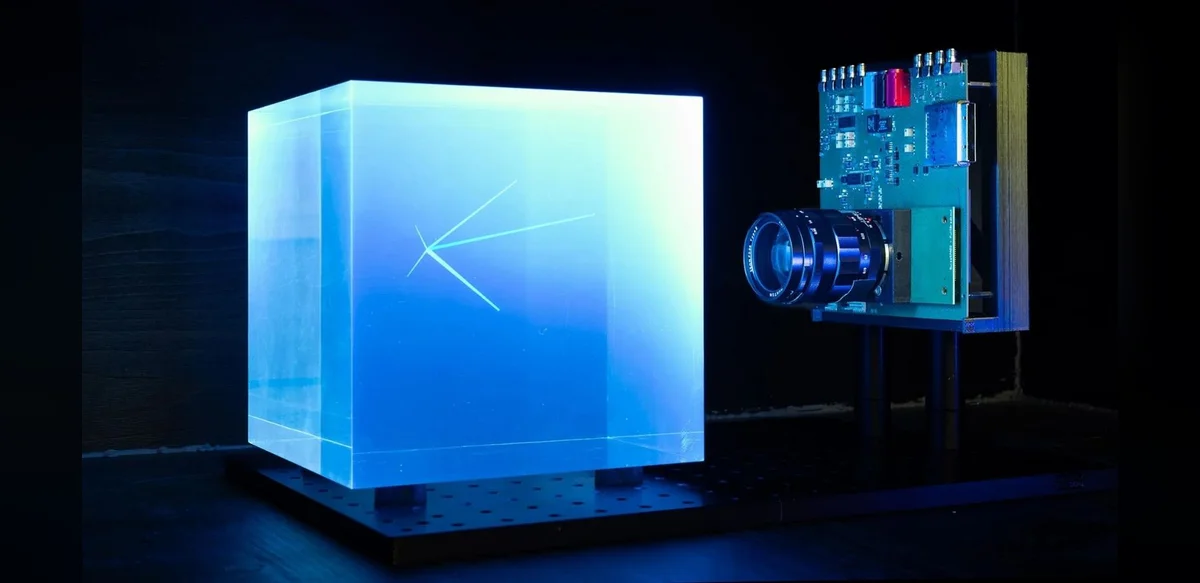
Scientists from ETH Zurich and EPFL created an innovative particle detection system known as PLATON. It could change how researchers study some of the universe’s hardest-to-detect particles. The system uses one solid block of light-emitting material instead of millions of small parts and relies on an AI-driven camera to map particle trajectories in three dimensions.
Published in Nature Communications, the study indicates this detector may perform as well as or better than current advanced models while being simpler to construct and expand. The team also sees potential uses in medical imaging like PET scanners.
Particle detectors are essential in physics research for following elementary particles through materials. Standard versions use scintillators that produce brief light flashes when hit by charged particles. These are usually split into many tiny sections linked by optical fibers and sensors to locate the events.

