

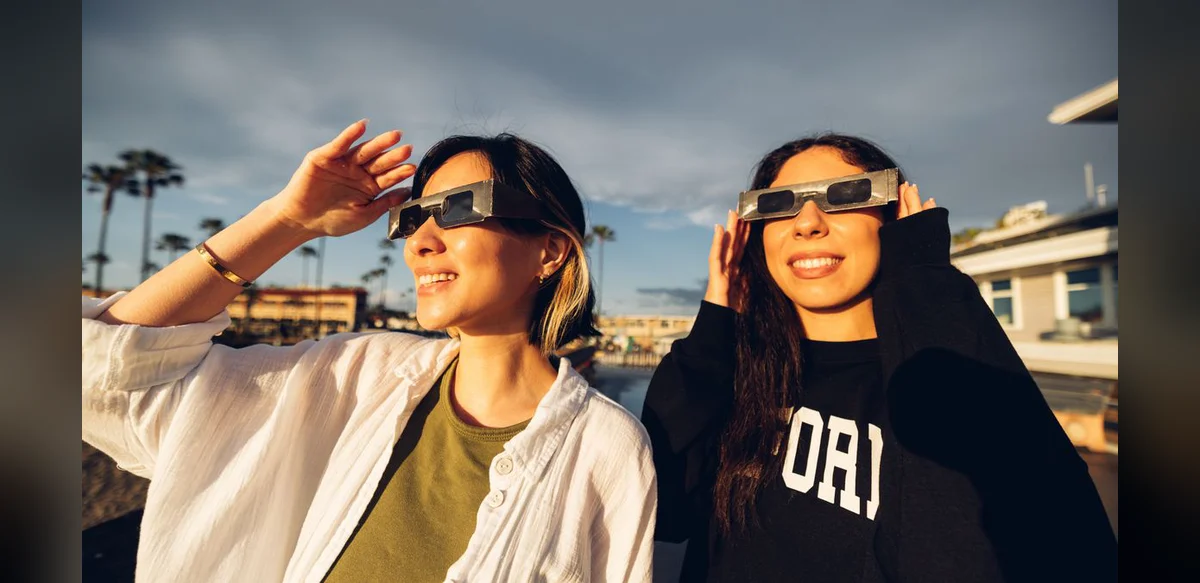
An ophthalmologist from the National Health Service has outlined practical ways for people to observe an upcoming solar eclipse safely. The guidance emphasizes protecting eyesight while still allowing viewers to experience the astronomical event. Four distinct methods were presented during a recent public health briefing, with three relying on everyday household items rather than specialized eclipse glasses.
Solar eclipses draw widespread interest, yet direct viewing without proper protection can cause serious and permanent damage to the retina. The doctor stressed that standard sunglasses offer insufficient shielding against the sun’s intense rays during these events. Instead, indirect observation techniques provide a safer alternative that avoids looking at the sun altogether.
One recommended approach involves creating a pinhole projector using two pieces of card. A small hole is made in one card, which then projects an image of the eclipsed sun onto the second card held below it. This method produces a clear, inverted view of the celestial alignment without any risk to the eyes. The size of the projected image can be adjusted by changing the distance between the cards, making it suitable for both individual and small group viewing.
A second technique uses a mirror to reflect the sun’s image onto a shaded surface indoors. By positioning a small mirror near a window, viewers can capture the eclipse reflection on a wall or piece of paper inside a darkened room. This setup allows multiple people to watch simultaneously from a comfortable location while remaining protected from direct sunlight.
The third option employs a simple colander or similar kitchen utensil with multiple holes. When held up to the sun, the colander casts numerous small projections of the eclipse onto the ground or a flat surface below. Each hole acts as its own pinhole camera, creating an array of crescent shapes during partial phases of the event. This approach is particularly engaging for families or educational settings.
The fourth method discussed does require certified solar filters or eclipse glasses meeting international safety standards. The doctor noted that these products must be verified for compliance with relevant safety certifications before use. Even with approved glasses, viewing should be limited to short intervals, and direct staring at the sun should still be avoided.
Public health officials accompanying the ophthalmologist highlighted the importance of preparing in advance for eclipse viewing. They advised checking local weather forecasts, as cloud cover can affect visibility, and encouraged communities to organize group viewings using the indirect methods to promote safety. Schools and community centers were specifically encouraged to adopt the projector techniques for student activities.
Eye care experts have long warned about the dangers of eclipse-related eye injuries. Cases of solar retinopathy increase significantly around major eclipse events when people attempt to view the phenomenon without adequate protection. Symptoms may not appear immediately, making prevention through education essential. The NHS guidance aims to reduce such incidents by providing accessible alternatives that require minimal resources.
The doctor also addressed common misconceptions about eclipse viewing. For instance, some believe that viewing during the brief period of totality is safe without filters, but this applies only to total eclipses and only during the exact moments when the sun is fully obscured. Partial phases, which last longer, demand full protection or indirect methods. Viewers were urged to consult reliable astronomical resources for precise timing in their location.
Additional tips included staying hydrated during outdoor viewing sessions and using comfortable seating arrangements for extended observation periods. The briefing concluded with a reminder that enjoying the eclipse safely ensures the experience can be appreciated without long-term health consequences. Health authorities plan to distribute further materials through NHS channels in the coming days.
This advice aligns with broader efforts to integrate astronomical events into public health messaging. By focusing on simple, replicable techniques, the ophthalmologist hopes to make eclipse viewing inclusive and risk-free for all age groups and abilities.


