

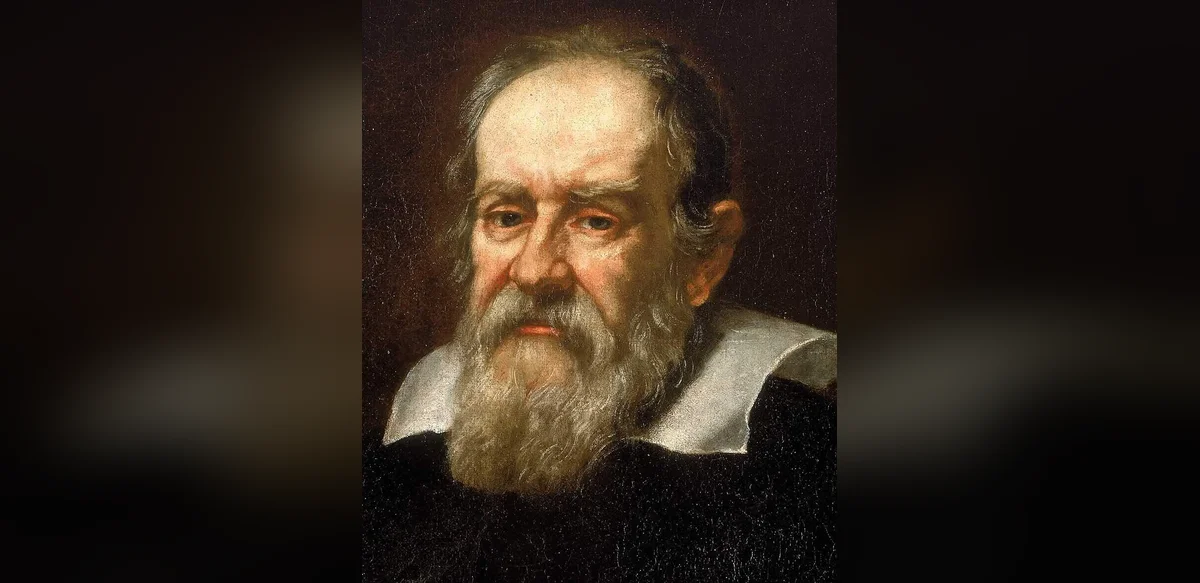
Galileo Galilei, whose research on falling objects and motion prepared the way for later demonstrations like the Apollo 15 experiment on the Moon. Image Credits: Wikimedia Commons.
Quote of the day by Galileo Galilei
“It is a beautiful and delightful sight to behold the body of the Moon.”
What Galileo Galilei actually meant
Written in the pamphlet that altered views on observation
Why this idea keeps returning
A simple way to apply this idea in everyday life
Other famous quotes by Galileo Galilei
“And yet it moves.”
“The surface of the Moon is not smooth, uniform, and precisely spherical… but is uneven, rough, and full of cavities and prominences.”
“In the sciences, the authority of thousands of opinions is not worth as much as one tiny spark of reason in an individual man.”
Two people can view the same familiar Moon and perceive it quite differently. One sees a flat, silver disk, a regular feature of the night sky often overlooked. The other examines the identical object with a new device and sees, for the first time, a real landscape with mountains, valleys, and shadows, nearly close enough to reach. Galileo Galilei had that second experience in the autumn of 1609, and he ensured others understood the shift. “It is a beautiful and delightful sight to behold the body of the Moon,” he wrote, presenting an object long known as if he were the first to truly observe it.
He was not offering a poetic view or general wonder at the night sky. His remark was precise and almost technical in its enthusiasm. With his improved telescope, the Moon ceased to be a smooth, unknown disk and became something like terrain, irregular, detailed, and marked by features similar to those on Earth. What he found beautiful was not the Moon as an idea, but the Moon as newly seen evidence.
Two observers side by side, one using the naked eye and one using Galileo’s telescope, would describe the same object in nearly unrecognizable terms. One saw a familiar light in the sky. The other saw craters, shadows from mountain ranges, and a rough surface that challenged long-held views that heavenly bodies were perfect, smooth spheres. Galileo’s pleasure came not from adding beauty to old knowledge but from watching an old assumption fade as new evidence appeared.
The line gains added importance from its source. Galileo published it in Sidereus Nuncius, or The Starry Messenger, a brief pamphlet issued in Venice in 1610 that first printed reports of his telescope findings: the Moon’s rough surface, four moons around Jupiter, and far more stars than visible without aid. The work spread rapidly among European scholars because it asked readers to verify for themselves rather than accept the author’s word alone.
That request met resistance. Some leading thinkers of the time refused to look through the telescope, calling the suggestion unworthy of serious attention, a stance Galileo found so odd he mentioned it in a letter to fellow astronomer Johannes Kepler. The pleasure in the quote takes on new meaning against this background. Galileo was not simply praising the Moon. He was quietly asserting that direct observation should outweigh inherited authority, at a time when such a statement carried professional and later personal risks.
The core experience in this quote, a common object changed by a fresh method of viewing, appears again in the history of scientific tools, from early microscope users finding a hidden world in a drop of water to modern astronomers seeing galaxies in deep-field images where earlier instruments showed only empty space.
Galileo described, in one of the first major cases, a pattern that repeats whenever a new instrument extends human sight beyond its natural range. This pattern explains why the quote remains cited far beyond astronomy history. It does not describe a personal response unique to one man’s telescope. It describes what occurs, consistently, when a tool allows people to see what they had only assumed before.
The practical step is to examine familiar objects more closely before concluding nothing new remains, since the object need not change for understanding of it to shift entirely.
A fair test is to ask, of something viewed many times


