

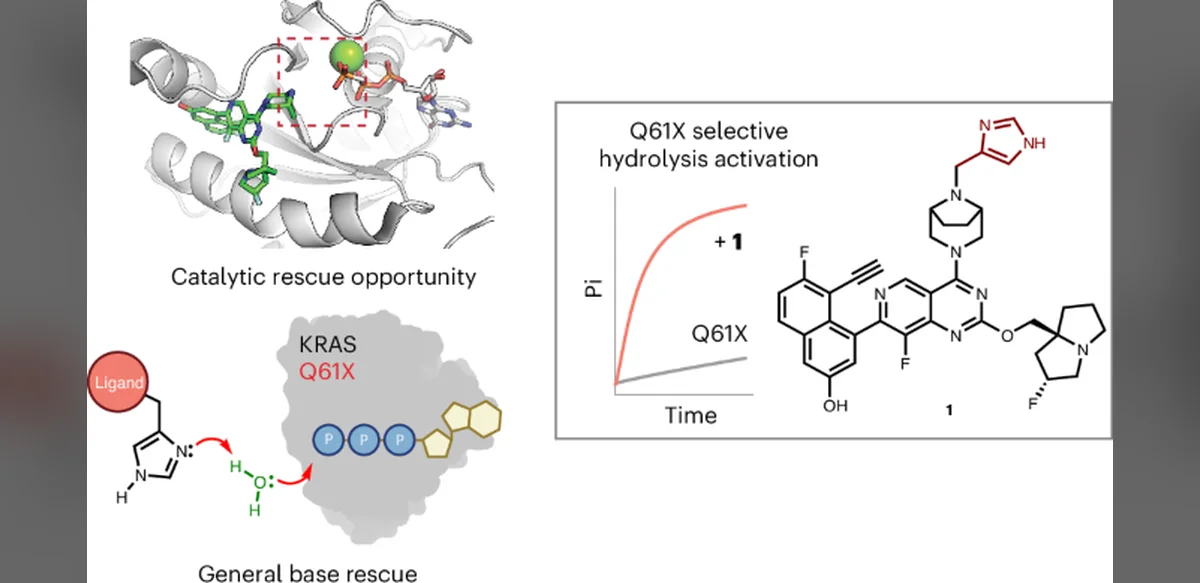
A recent study published in Nature Chemical Biology describes how certain small molecules can help restore a key biochemical function in mutated versions of the KRAS protein. The work focuses on variants where the amino acid glutamine at position 61 is replaced by other residues. These changes, known as Q61X mutations, disrupt the protein’s ability to break down GTP, a molecule that controls signaling pathways inside cells.
The KRAS protein normally acts as a molecular switch. When bound to GTP it is active and transmits signals that influence cell growth and division. Proper hydrolysis of GTP to GDP turns the switch off. In many Q61 mutants this hydrolysis step is impaired, leaving the protein stuck in the active state. The new research shows that Brønsted-basic small molecules can compensate for the missing glutamine side chain through a process called chemical complementation.
In laboratory tests the molecules increased the rate of GTP hydrolysis by as much as twenty times compared with the mutant protein alone. This rescue effect was observed across several different amino-acid substitutions at the Q61 site. The findings provide a proof-of-concept that synthetic compounds can supply a missing catalytic feature and partially correct the biochemical defect.
The study used purified proteins and controlled reaction conditions to measure hydrolysis rates. Results indicated that the small molecules interact with the mutant active site in a way that stabilizes the transition state for phosphate cleavage. Because the approach relies on chemical complementation rather than restoring the original amino acid, it offers a distinct strategy from traditional genetic or protein-engineering methods.
Scientists note that KRAS mutations occur in a substantial fraction of human cancers, and the Q61 position is one of several hotspots. Restoring GTPase activity in these mutants has long been considered a therapeutic goal. The current work does not report cellular or animal data, but it establishes that small molecules can accelerate hydrolysis in isolated mutant proteins.
Further experiments will be needed to determine whether the same compounds function inside living cells and whether they produce meaningful biological effects. Questions also remain about selectivity, as the molecules must act on mutant KRAS without interfering with the many other GTPases present in cells. The authors emphasize that the study is an early-stage demonstration of chemical rescue rather than a ready therapeutic candidate.
The research contributes to a growing field that explores how synthetic chemistry can address loss-of-function mutations. By supplying a missing catalytic group through a small molecule, the method expands the range of possible interventions beyond those that target the protein surface or allosteric sites. Future investigations may test additional compound libraries and examine whether similar complementation strategies apply to other oncogenic mutants.
Overall the paper illustrates how detailed mechanistic understanding of enzyme catalysis can guide the design of simple chemical tools. The reported twenty-fold acceleration provides a quantitative benchmark for subsequent optimization. While clinical applications remain distant, the findings open a new line of inquiry into chemical approaches for modulating mutant protein activity.


