

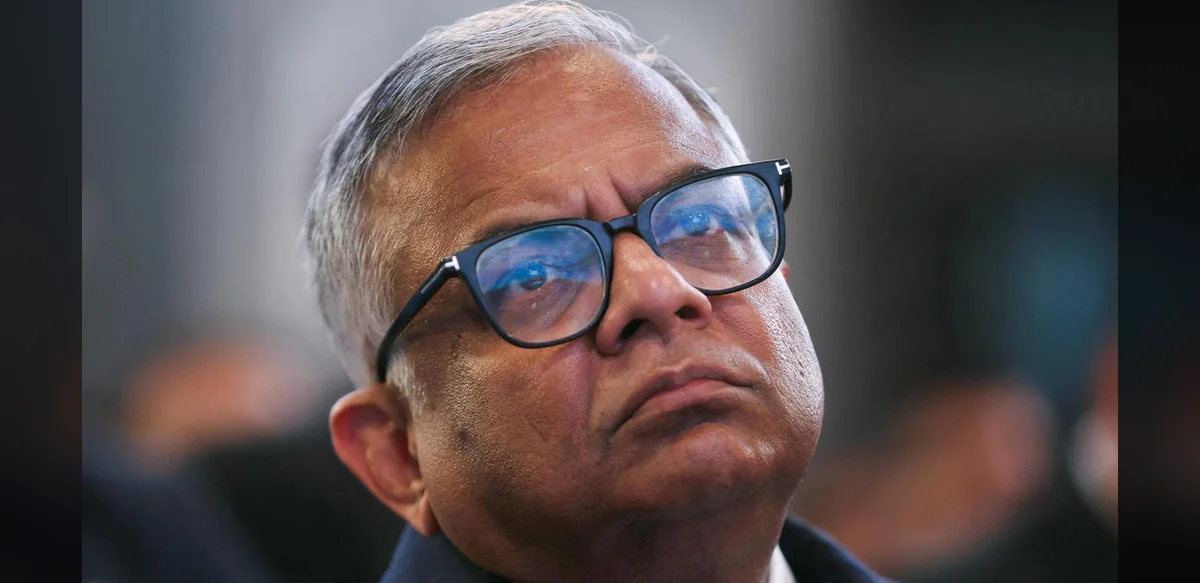
Natarajan Chandrasekaran, chairman of Tata Sons, will leave the position at the conclusion of his term in February 2027. He is credited with steering the Tata Group toward technology-focused ventures after assuming leadership in 2017.
The executive who led Tata Consultancy Services for eight years before being chosen to head the conglomerate under difficult conditions guided the organization through new areas. These included large commitments to semiconductors, electronics production, consumer internet platforms, mobile technology and battery manufacturing facilities, sectors previously outside the group’s traditional scope.
During his tenure the Tata Group strengthened its aviation operations by acquiring Air India, aiming to develop an international carrier based in India.
As the first non-Parsi to lead the group, Chandrasekaran received full support from his predecessor and mentor, former Tata Sons chairman Ratan Tata, until the latter’s death in October 2024.
Following the abrupt removal of former chairman Cyrus Mistry after a board dispute, Chandrasekaran joined the Tata Sons board in October 2016 and was named chairman in January 2017 after a selection committee approved his appointment.
A group veteran who served on the committee described him as the most successful chief executive within the Tata companies at the time and the obvious selection.
Before taking the top role at Tata Sons, Chandrasekaran served as chief executive of TCS. He joined the company as a trainee in 1987 and remained for thirty years, including eight years as CEO until 2017. Under his direction TCS became India’s most valuable company and expanded in international markets despite challenging conditions.
While Ratan Tata strengthened the group’s core operations through major overseas acquisitions, raised Tata Sons’ stakes in subsidiaries and maintained firm oversight, Chandrasekaran focused on integration, simplification and growth via the One Tata approach. He also advanced the group’s shift toward long-term sustainability.
Close to Ratan Tata, Chandrasekaran faced internal tensions within Tata Trusts, which holds 66 percent of Tata Sons and influences major decisions.
Noel Tata, half-brother of Ratan Tata, became chairman of Tata Trusts in October 2024 after his brother’s death. Subsequent changes affected both Tata Trusts and Tata Sons, with several longtime associates departing and further exits expected.
Chandrasekaran’s departure stems from uncertainty over an extension. In a statement he noted that although Tata Trusts and the nomination and remuneration committee had approved a third five-year term beginning February 2027, one board member did not support it, creating ambiguity.
Chandrasekaran was also assigned to address the potential listing of Tata Sons, sought by the Shapoorji Pallonji Group holding roughly 18 percent, in line with regulatory requirements. He was further tasked with reducing losses at underperforming units including Air India and Tata Digital.
Over nearly ten years he managed the group through multiple difficulties, such as the Air India plane incident, a cyberattack at Jaguar Land Rover and ongoing cash outflows at Tata Neu. He leaves with several objectives incomplete despite plans to continue for another five years.
By announcing his exit six months early, the executive with almost forty years at the group allowed time to identify a successor.
Born in 1963, Chandrasekaran holds a bachelor’s degree in applied sciences and a master’s in computer applications. He received the Padma Bhushan and France’s Legion d’Honneur in 2023, along with an honorary knighthood from Britain in 2025. Several universities have awarded him honorary doctorates, and he authored the book Bridgital Nation on technology and development.


