

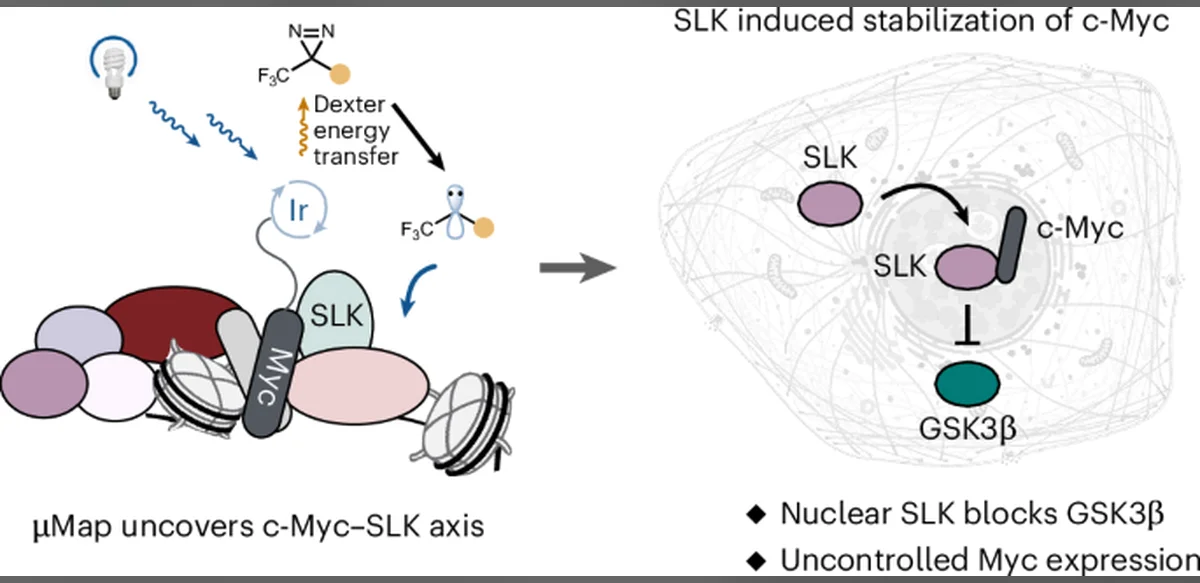
A recent investigation published in Nature Chemical Biology has introduced a photoproximity labeling technique to identify partners of the c-Myc oncoprotein that are specific to cancer cells. The approach highlights the kinase SLK as a key co-regulator that binds to and stabilizes c-Myc, thereby promoting tumor growth. This discovery provides fresh insights into strategies for addressing c-Myc, a protein long considered challenging to target therapeutically.
The c-Myc protein plays a central role in regulating cell growth and is frequently overexpressed in various cancers. Researchers have sought methods to disrupt its activity without affecting normal cellular functions. The photoproximity labeling method allows scientists to capture transient interactions in living cells by using light to activate labeling of nearby proteins. This enables mapping of cancer-specific associations that might otherwise remain undetected.
In the study, the technique revealed that SLK interacts with c-Myc primarily in cancerous environments. The binding leads to stabilization of c-Myc levels, which in turn supports uncontrolled cell proliferation characteristic of tumors. Experiments demonstrated that reducing SLK activity resulted in decreased c-Myc stability and slowed tumor progression in models examined.
These findings suggest that SLK could serve as a potential point of intervention for cancers driven by c-Myc. Unlike direct targeting of c-Myc, which has proven difficult due to its structure, focusing on its cancer-specific regulators like SLK may offer a more feasible path. The research emphasizes the value of proximity-based tools in uncovering context-dependent protein networks.
Further analysis showed that the interaction between SLK and c-Myc is not prominent in non-cancerous cells, underscoring its specificity. This selectivity could minimize side effects in potential treatments. The photoproximity approach itself represents an advancement in chemical biology, allowing precise exploration of dynamic protein partnerships under physiological conditions.
The implications extend to broader cancer research, where similar methods might identify other undruggable targets. By distinguishing cancer-specific mechanisms, scientists can develop more precise therapies. The study calls for additional investigations to validate SLK as a drug target across different cancer types and to refine the labeling technology for wider applications.
Overall, this work contributes to the ongoing effort to understand and combat oncoproteins like c-Myc through innovative biochemical strategies. It underscores the importance of context in protein function and opens avenues for future therapeutic development in oncology.


