

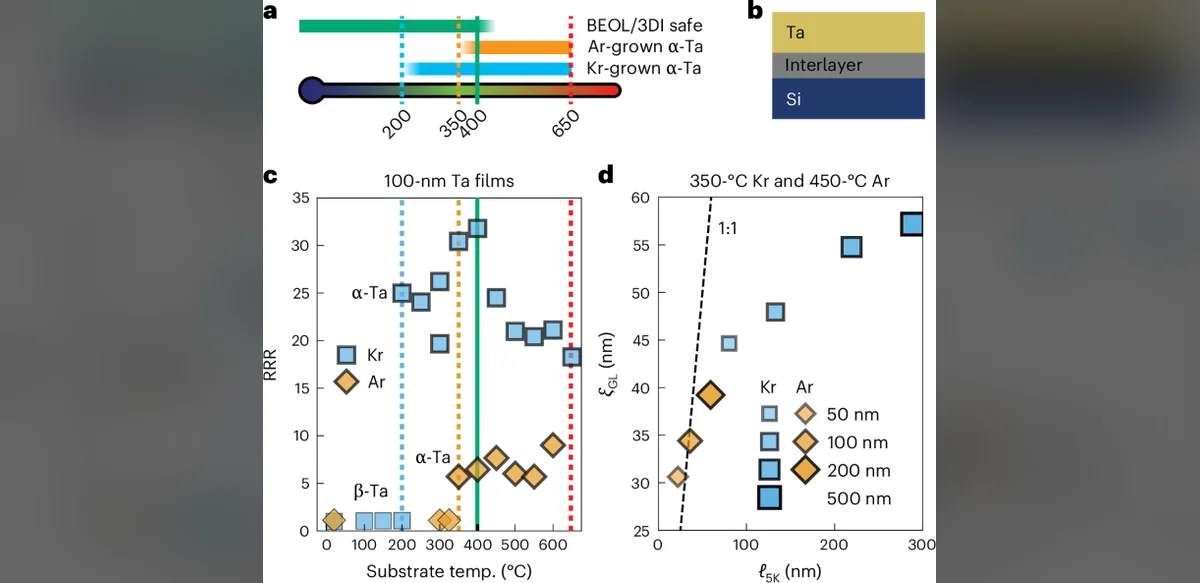
Researchers have identified a method using krypton sputtering that supports the creation of body-centered cubic tantalum films on silicon substrates. This process operates effectively at temperatures down to 200 degrees Celsius. Such conditions align with standard back-end-of-line fabrication requirements in semiconductor manufacturing. The resulting films form the basis for superconducting qubits that demonstrate strong operational characteristics.
The approach addresses challenges in producing high-quality materials for quantum technologies at scales suitable for industrial processes. Traditional methods often require higher temperatures that can interfere with existing chip production flows. By lowering the thermal threshold while maintaining film quality, the technique offers a pathway toward integrating quantum components with conventional electronics.
Quantum devices rely on precise material properties to achieve coherence and minimize errors. Tantalum in its body-centered cubic structure provides favorable superconducting behavior. The krypton-based deposition promotes this phase formation without compromising compatibility with silicon platforms widely used in electronics.
Industry standards for back-end-of-line steps emphasize controlled environments to protect underlying circuitry. The reported temperature compatibility reduces risks associated with thermal stress during integration. This could facilitate larger-scale fabrication of quantum processors alongside classical components.
Performance evaluations of qubits constructed from these films indicate reliable metrics in key areas such as coherence times and gate fidelities. These outcomes suggest the material system holds promise for advancing quantum hardware beyond laboratory demonstrations.
Further development may explore variations in deposition parameters to optimize film thickness and uniformity across wafers. Consistent results at the wafer level remain essential for transitioning from research prototypes to production volumes.
The findings contribute to ongoing efforts in materials engineering aimed at quantum information science. Low-temperature synthesis routes like this one help bridge gaps between fundamental research and applied manufacturing constraints.
Continued investigation into alternative sputtering gases and substrate preparations could yield additional improvements. However, the current results establish krypton sputtering as a viable option for tantalum film growth under practical conditions.
Overall, the work highlights how targeted adjustments in thin-film deposition can support the evolution of scalable quantum technologies while respecting established semiconductor process limits.


