

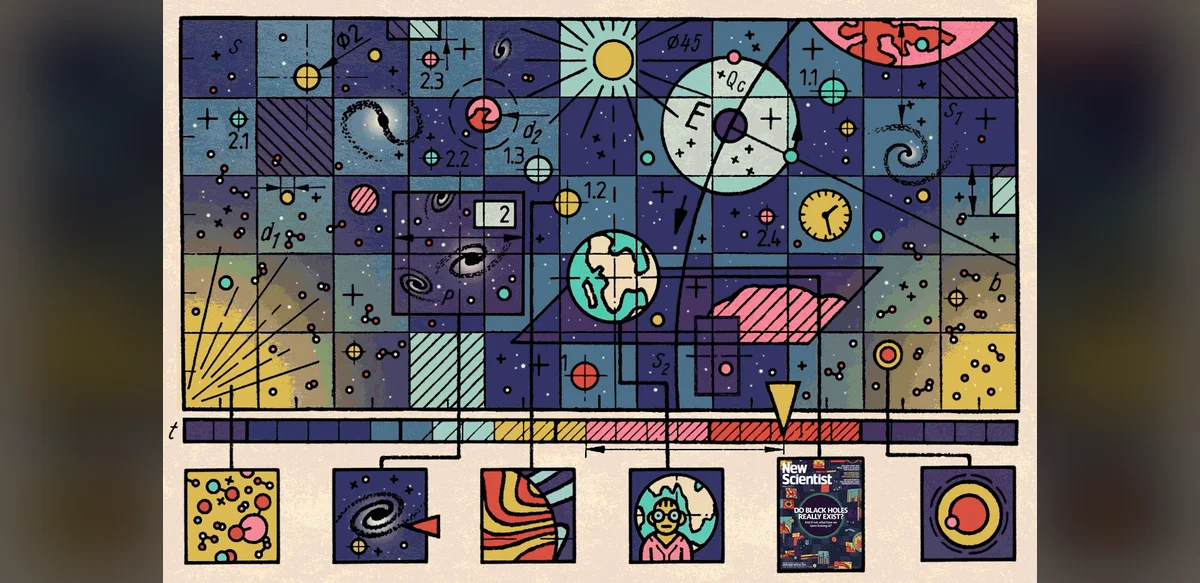
In recent discussions within theoretical physics, experts have examined the unsettling idea that conscious observers might arise merely as chance events amid a largely lifeless cosmos. This perspective stems from considerations of statistical mechanics and the vast timescales involved in an expanding universe that continues indefinitely. Rather than accepting a scenario dominated by isolated, random mental states, one prominent line of thought proposes an alternative framework where existence unfolds in a continuous loop without beginning or end.
This approach draws on principles from quantum mechanics and cosmology to argue that the universe could exhibit periodic behavior on enormous scales. Under such conditions, all possible configurations of matter and energy would recur repeatedly. The implications extend beyond mere repetition to suggest a form of stability that counters the isolation implied by fluctuation-based origins of awareness. Observers would then form part of a structured, recurring pattern rather than fleeting anomalies.
Proponents highlight several constructive aspects to this model. First, it provides a coherent explanation for the persistence of ordered structures and the apparent fine-tuning observed in physical laws. Instead of relying on improbable accidents, the repeating nature ensures that complex systems emerge consistently across cycles. This offers a sense of continuity that aligns with empirical observations of cosmic evolution while avoiding paradoxes associated with infinite random occurrences.
Furthermore, the framework encourages deeper inquiry into the fundamental nature of time and causality. By envisioning reality as cyclic, researchers can explore connections between quantum states and large-scale geometry in novel ways. Such investigations might yield insights into unresolved questions about entropy and the arrow of time, potentially unifying disparate areas of study under a single overarching principle.
Critics note that verifying these ideas remains challenging due to the immense scales involved, far beyond current observational capabilities. Nevertheless, the proposal stimulates productive debate and mathematical modeling that refines our understanding of possible cosmic histories. It also prompts reflection on philosophical questions regarding identity and experience within a looped existence, where individual moments could echo across iterations.
Overall, this viewpoint shifts emphasis from existential randomness toward structured recurrence, opening avenues for both scientific advancement and conceptual clarity. As theoretical tools evolve, further refinements may clarify whether such eternal repetition represents a viable description of our reality or serves primarily as a useful heuristic for exploring boundaries of known physics.


