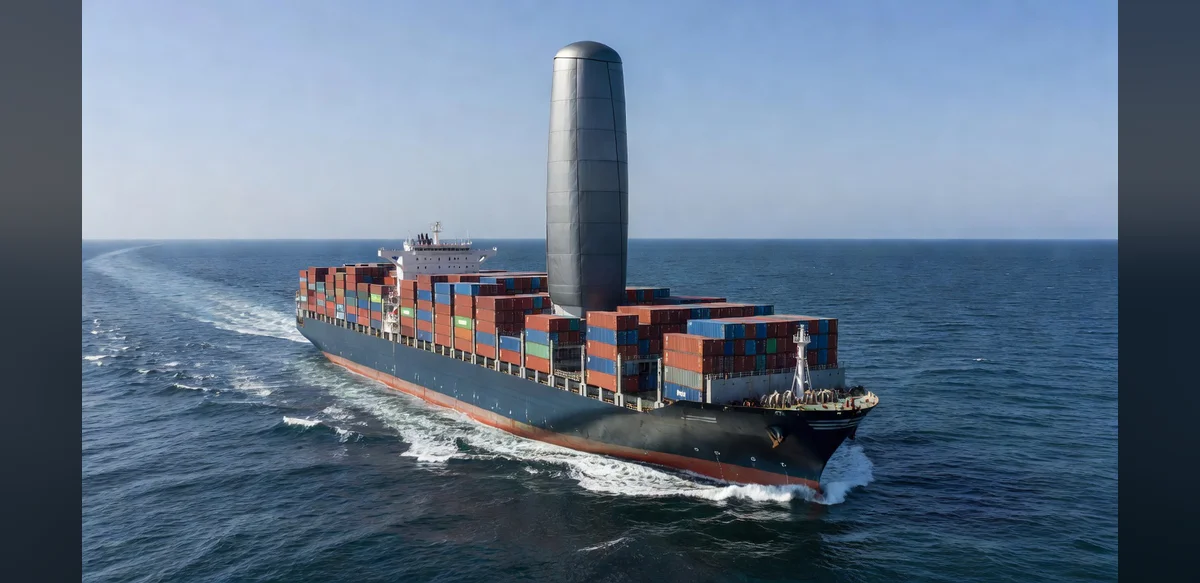
Danish shipping company Maersk has announced plans to introduce wind assisted technology across part of its container vessel operations. The initiative involves fitting a rotor sail device measuring 35 meters in height onto one vessel with a capacity of 8700 standard containers. The installation is scheduled to take place during the following year. This step represents an effort to explore alternative propulsion methods that rely partly on wind power. The selected supplier for the equipment is a British firm known as Anemoi Marine Technologies. Under the agreement the company will handle both the design and production of the unit. The rotor itself will be a single fixed structure with a diameter of five meters and a total height of 35 meters. Once installed the device is expected to contribute to reduced fuel consumption by harnessing wind energy during voyages. Shipping lines have shown increasing interest in such technologies as part of broader efforts to lower emissions in maritime transport. The rotor sail functions by creating forward thrust when wind passes over its spinning surface. This approach differs from traditional sails and can be integrated onto existing vessel designs with minimal structural changes. Maersk has selected one of its mid sized container ships for the initial trial. The project will allow the company to gather operational data on performance reliability and maintenance requirements under real world conditions. Industry observers note that wind assisted propulsion systems offer a supplementary power source rather than a complete replacement for engines. The technology is viewed as one option among several being tested to meet future environmental targets in global trade. Anemoi Marine Technologies specializes in the development of rotor sail systems for commercial vessels. Their involvement ensures that the equipment meets necessary safety and engineering standards for large scale maritime use. The fixed nature of the rotor means it will remain in position without folding mechanisms which simplifies the installation process. Following the pilot phase Maersk may evaluate whether similar devices could be applied to additional ships in its fleet. The announcement aligns with ongoing discussions within the maritime sector about adopting low emission solutions. Container shipping plays a central role in international commerce and any efficiency gains can have wide reaching effects on overall energy use. The 8700 teu vessel chosen for the test operates on established trade routes where wind patterns may provide consistent opportunities for the rotor to function effectively. Data collected during the trial period will help determine the practical benefits in terms of fuel savings and emissions reduction. Both companies involved have emphasized a focus on engineering precision and operational safety throughout the project. The rotor sail represents a modern adaptation of older wind propulsion concepts updated with contemporary materials and control systems. As the installation date approaches further details regarding integration and crew training are expected to emerge. This pilot forms part of wider industry exploration into sustainable practices without altering core vessel operations. The collaboration between Maersk and Anemoi highlights how established shipping operators and specialized technology providers can work together on innovation projects. Results from the trial will likely inform future decisions on scaling such technologies across larger portions of the global fleet. Overall the initiative underscores a measured approach to testing new equipment before wider adoption. The dimensions of the rotor have been carefully chosen to balance thrust generation with vessel stability and clearance requirements. With the project set to begin next year attention will turn to monitoring its performance across varying sea and weather conditions. Such tests are essential for validating the technology in the demanding environment of container shipping. The neutral stance of the companies involved suggests a commitment to evidence based evaluation rather than premature claims of success. In summary the planned installation marks a notable development in efforts to incorporate wind power into modern containership design and operation.