

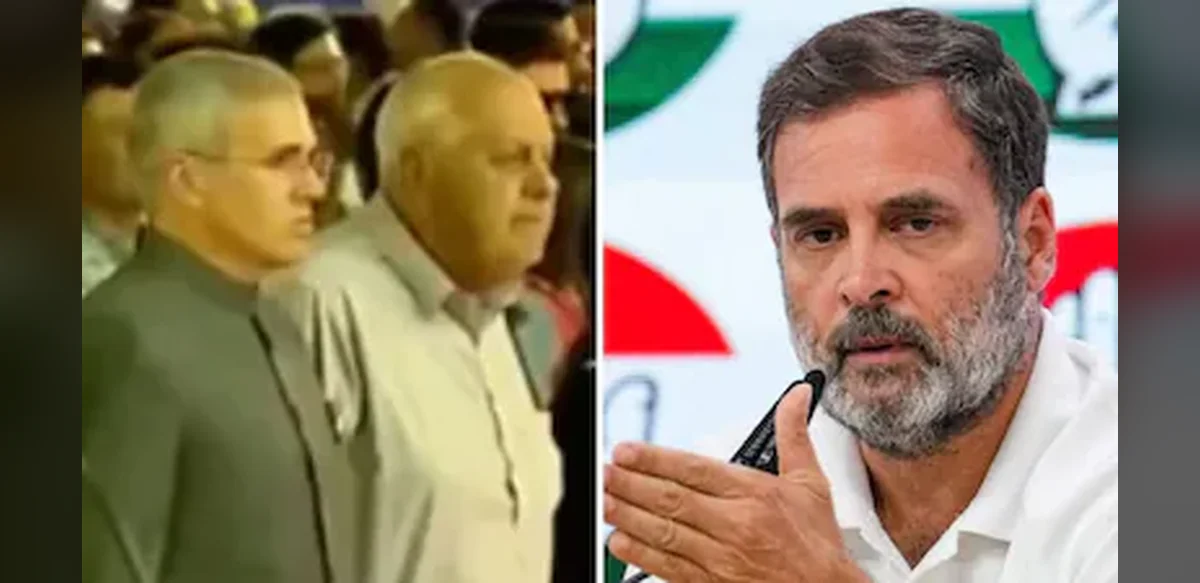
The recent rendition of Vande Mataram at an event in Jammu and Kashmir has drawn attention to differing views within the opposition alliance. During the territory’s first international film festival held on September 8, Chief Minister Omar Abdullah and former chief minister Farooq Abdullah remained standing for the full six-stanza version of the national song. The decision at the official program prompted a response from the Congress party, which favors limiting official performances to the first two stanzas.
Congress general secretary K C Venugopal stated on social media that the complete version does not align with the party’s view of India’s pluralistic traditions. He referenced historical figures from the independence movement, including Mahatma Gandhi, Jawaharlal Nehru, Sardar Vallabhbhai Patel, Subhas Chandra Bose, Rajendra Prasad, Acharya Narendra Dev, Maulana Abul Kalam Azad, Sarojini Naidu, and J B Kripalani, along with the influence of Rabindranath Tagore. The party maintains that the shorter version was chosen during the freedom struggle to avoid any perception of communal bias and to uphold secular principles.
Omar Abdullah responded by noting that the Congress position had already been clarified and that the full version was used at the film festival. He described the situation as one of adjustment for political groups and the public regarding the inclusion of the song in official protocols in Jammu and Kashmir. The chief minister indicated no intention to escalate the matter into a broader dispute.
The exchange occurs against the backdrop of the alliance between Congress and the Jammu and Kashmir National Conference. The two parties work together in the INDIA bloc at the national level and maintain a support arrangement in the union territory, where Congress provides legislative backing to the National Conference-led administration. The differing approaches to the national song have placed the partners on separate sides of a sensitive cultural and political question.
This episode reflects ongoing discussions within opposition groups about national symbols and their presentation. While Congress links its stance to historical decisions aimed at preserving inclusivity, allied parties may view the issue through a different lens. The National Conference leadership’s choice to observe the complete rendition, followed by the public clarification from Congress, underscores the distinct perspectives within the partnership.
The controversy adds to recent instances where members of the INDIA bloc have shown variations in approach on matters outside their shared opposition to the ruling party at the center. For Congress, the matter connects to its interpretation of secular traditions. For its partners, the rendering of the national song may carry different weight in local political contexts.
Historically, Vande Mataram served as a prominent slogan during the independence movement. Over time, Congress has consistently advocated for the first two stanzas in official settings, citing the need to reflect India’s diverse character. Critics have questioned this evolution, while the party continues to ground its position in decisions made by leaders during the freedom era.
The current disagreement involves an ally rather than an opponent, making the public exchange notable. Abdullah’s comments sought to minimize tension by emphasizing ongoing adjustments. Congress, however, reiterated its preference for the established shorter version. The episode illustrates how questions around national symbols continue to test coordination among political partners in Jammu and Kashmir and beyond.
Observers note that such differences may require further dialogue to maintain unity on shared objectives while respecting individual party positions. The film festival incident has thus become a point of reference in conversations about alliance management and cultural protocols in the region.


