

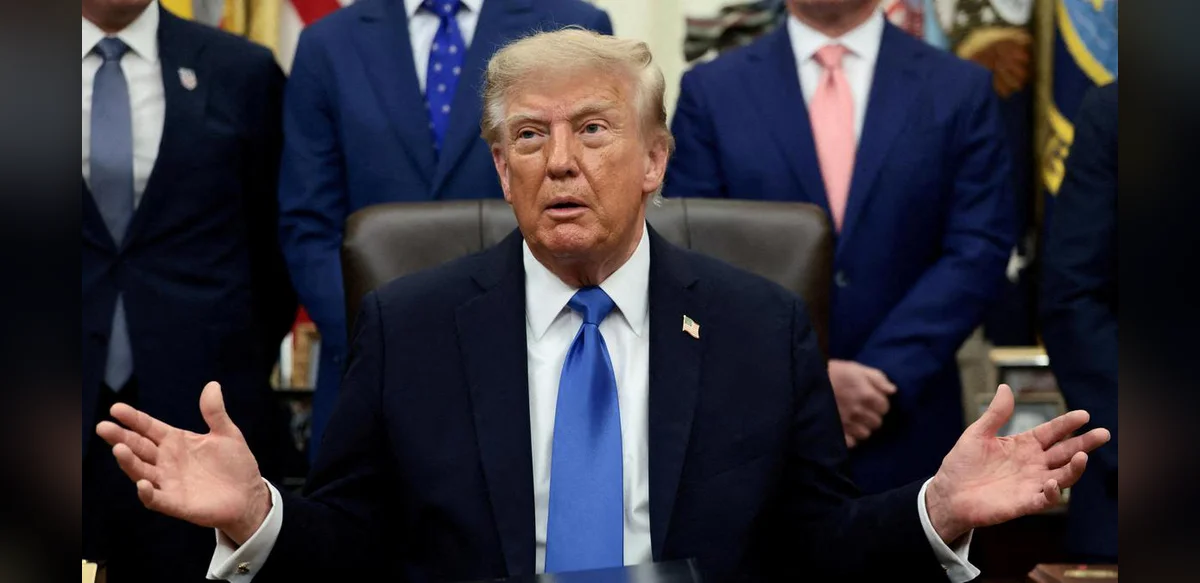
Former President Donald Trump has stated that artificial intelligence requires no additional regulatory measures beyond effective leadership at the highest level of government. In remarks attributed to him, Trump emphasized that the sole necessary form of control for AI systems involves a capable and intelligent chief executive, asserting that the United States currently possesses such leadership.
The comments address ongoing discussions about potential frameworks for managing emerging technologies. Trump dismissed suggestions for new restrictions, positioning presidential authority as sufficient to guide development in this area. Observers note that the statement aligns with broader views favoring minimal intervention in technological progress.
Artificial intelligence continues to advance rapidly across multiple sectors, including computing, automation, and data processing. Data centers supporting these systems have expanded significantly in recent years to meet growing demands for processing power and storage. Industry analysts track these trends closely, highlighting both opportunities and challenges associated with large-scale implementation.
Public discourse on technology governance often centers on balancing innovation with safety considerations. Various stakeholders, including policymakers and technology firms, have proposed different approaches to oversight. Trump’s position underscores a preference for executive decision-making over layered regulatory structures.
The technology sector has seen substantial investment in infrastructure projects worldwide. Facilities dedicated to data management and AI training require substantial resources, including energy and cooling systems. These elements form the backbone of modern digital operations and influence economic strategies in numerous regions.
Critics of expanded regulations argue that excessive rules could hinder competitiveness and slow advancements. Proponents of guidelines, however, point to risks such as misuse or unintended consequences. The debate reflects differing priorities regarding the pace and direction of technological change.
Trump’s remarks come amid heightened attention to AI capabilities and their societal impacts. Supporters view the emphasis on strong leadership as a pragmatic stance that leverages existing governmental structures. Detractors may interpret it as insufficient for addressing complex technical issues.
Data centers play a central role in enabling AI functionalities by providing the necessary computational resources. Their design and operation involve considerations of efficiency, security, and scalability. Global expansion of such facilities continues as demand rises for cloud services and machine learning applications.
Neutral reporting on these topics requires attention to verified statements and documented developments. The focus remains on presenting positions accurately without introducing unsubstantiated claims. Future policy decisions will likely shape how AI integrates into everyday systems and industries.
In summary, the statement highlights a viewpoint that prioritizes executive oversight for artificial intelligence. It contributes to conversations about appropriate mechanisms for guiding technological evolution. Readers are encouraged to consult multiple sources for comprehensive understanding of the subject.


