


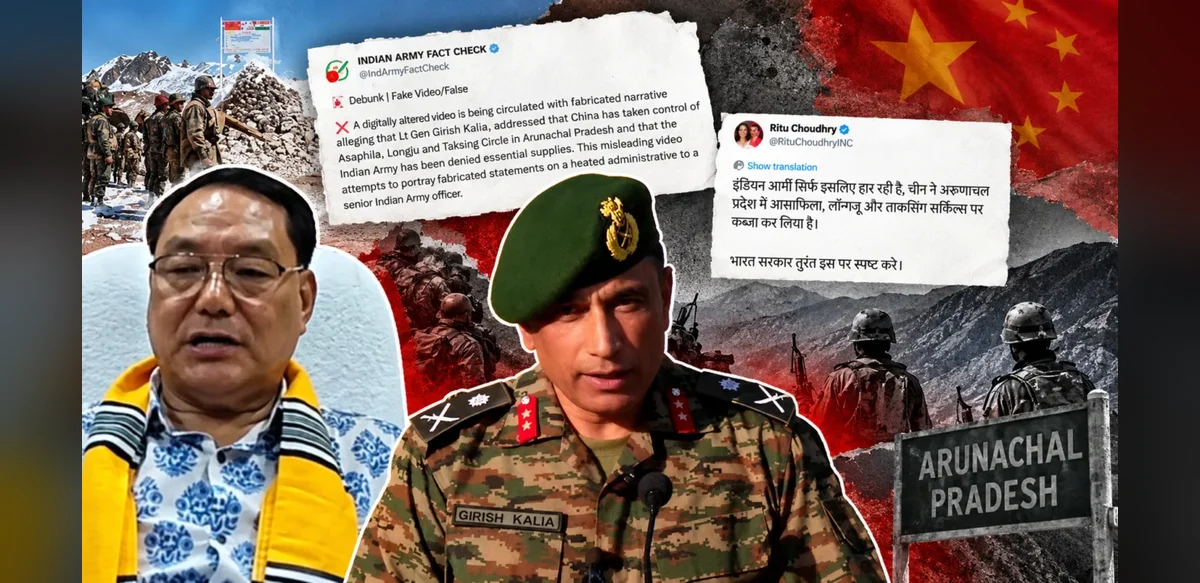
Union Minister Kiren Rijiju has strongly criticized the Congress party, urging it to issue a public apology to the country. The demand stems from the circulation of a video that authorities have described as artificially generated and misleading. The footage reportedly suggests serious lapses in security along the frontier with China in the northeastern state of Arunachal Pradesh. Officials from the Indian Army have already examined the material and declared it inauthentic.
The disputed clip combines older military recordings with invented statements. It alleges that Chinese personnel have occupied specific locations inside Indian territory and that local troops lack basic provisions. These assertions have been rejected by military spokespersons who examined the source material. The original recording dates back to a press interaction held in another region during late 2023 and addressed entirely different operational matters.
Rijiju stated that spreading such material harms the reputation of the armed forces and amounts to an act of disloyalty. He compared the circulation of the video to actions typically associated with adversaries of the nation. The minister further suggested that the opposition is pursuing a line of communication that ultimately benefits external interests hostile to India. He emphasized that political organizations bear a duty to verify information before amplifying claims related to national security.
The Army’s verification unit released a detailed clarification on the same day. It noted that the video wrongly attributes comments to a senior officer named Lieutenant General Girish Kalia. The fabricated remarks claim control of areas such as Asaphila, Longju and Taksing Circle by foreign forces along with denial of supplies to Indian personnel. In reality, the 2023 briefing focused on successful prevention of infiltration attempts across a different border and the neutralization of several militants. No references to the claimed locations or supply issues were made.
Separately, the president of the Congress unit in Arunachal Pradesh, Bosiram Siram, held a press conference in Pasighat. He alleged that foreign troops had moved several dozen kilometers into Indian-administered land within the Upper Subansiri district. The claim is based on observations made by a party delegation that toured border villages between late August and early September. Siram described restrictions faced by residents engaged in traditional activities such as livestock grazing and collection of forest resources. He also mentioned reported physical encounters between soldiers during the final days of July.
The delegation reportedly included other senior party figures and traveled through multiple settlements near the frontier. Local residents were said to have shared accounts of movement limitations and communication difficulties. Siram called for improved infrastructure including reliable roads and connectivity for security personnel stationed in remote posts. He further requested a formal inquiry into the situation and questioned why certain meetings with visiting dignitaries were not permitted.
Authorities have not yet provided an independent assessment confirming the extent of any territorial advance. The Army continues to monitor the overall border situation and has reiterated that all official statements on operational matters must come through authorized channels. Political observers note that claims involving frontier security require careful handling to avoid escalation or misinformation.
The episode has renewed discussion about the role of digital content in shaping public perception of sensitive issues. Fact-checking mechanisms within the military have become more prominent in recent years as altered videos circulate rapidly on social platforms. Both the minister and the opposition leader have highlighted the need for accurate information when addressing matters of territorial integrity and troop welfare.
Questions remain regarding the origin of the altered video and the verification process for allegations made by political representatives. Government sources stress that any substantive claims about border conditions should be supported by evidence presented through proper institutional routes. The situation underscores ongoing challenges in managing information flow during periods of heightened attention to frontier regions.

