


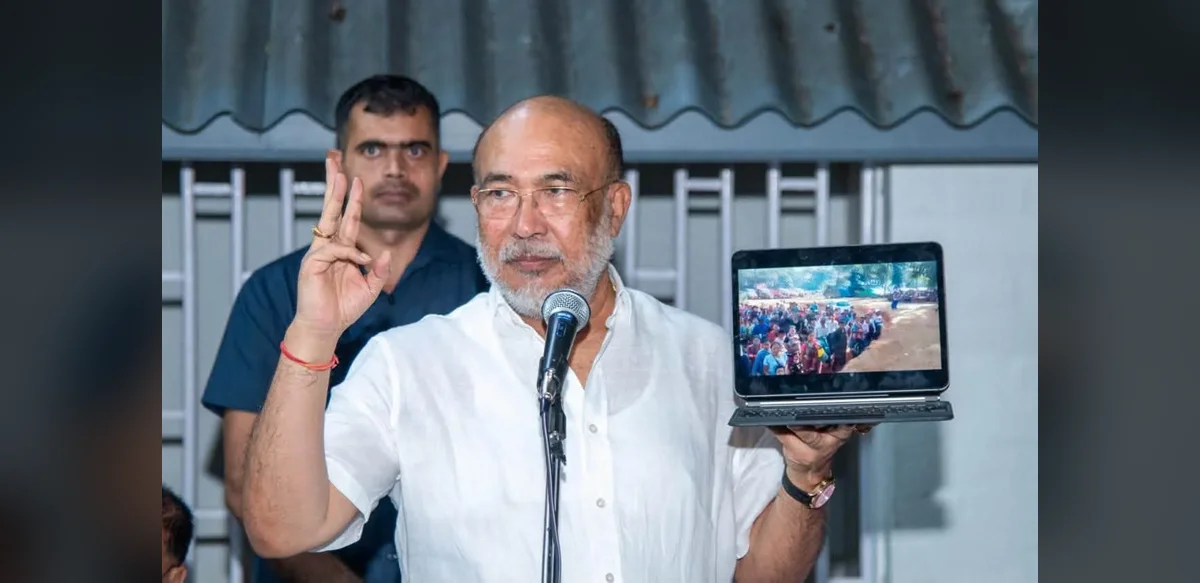
The push for fresh biometric statistics on undocumented migrants in Manipur has once again highlighted the state’s ongoing identification process, its progress over recent years, and the call for clearer public reporting on efforts to track such individuals. Former Chief Minister and BJP legislator N. Biren Singh posted on social media platform X urging the state Home Department to release regular updates on biometric collections, including numbers of people identified and confirmed as illegal entrants. His statement came after news that Mizoram had advanced to the concluding stage of similar enrolment for refugees from Myanmar sheltering in that state. Singh pointed to the Mizoram example while stressing the need to track cross-border movements and protect security interests. He described the matter as unrelated to partisan matters and focused instead on border protection and community welfare.
The state government launched a structured process in February 2023 to locate undocumented nationals from Myanmar. At that time the cabinet formed a sub-committee led by the Tribal Affairs and Hills Minister. Two former ministers joined as members. The Home Department later set up an executive committee in March 2023 to carry out field verification across several hill districts such as Chandel, Tengnoupal, Churachandpur, Pherzawl and Kamjong.
In May 2024 the then Chief Minister reported that 2,480 illegal entrants had been found in the first phase. He added that biometric records had been gathered from 5,173 out of 5,457 additional Myanmar nationals identified in Kamjong district. Work slowed after ethnic clashes began on 3 May 2023. On 6 August 2024 the state assembly passed a unanimous resolution to create a 12-member house committee tasked with reviewing illegal immigration and the appearance of new settlements. The former Chief Minister introduced the proposal and another former minister was named to lead the panel. These steps created the early administrative and legislative structure for the identification work.
Recent assembly disclosures by the current Home Minister on 7 September 2026 listed 24,475 detected illegal entrants from Myanmar. Of that total 14,992 were said to have returned to Myanmar while 9,453 stayed in the state, mostly in temporary facilities. District breakdowns showed 14,370 in Chandel, 6,545 in Kamjong and 3,560 in Tengnoupal. The minister noted that biometric details had been taken from 1,308 of the 4,770 individuals still present in Chandel. These numbers illustrate the difference between initial detection, biometric recording and full verification. Detection totals alone do not show how many cases reached completed enrolment or confirmation stages. District-level details on enrolment status, pending checks, finished identifications and returns to Myanmar would give a clearer view of overall advancement.
The identification effort has also been connected to repeated calls for updating the National Register of Citizens in Manipur. The assembly passed an NRC resolution in August 2022 and renewed it in March 2024. Civil society groups have pressed for implementation using 1951 as the base year. In September 2026 the Home Minister told the assembly that the state would seek NRC revision with that base year and was locating original records. He noted that full rollout would need central government approval. Biometric enrolment and NRC revision remain distinct processes. Biometric data can support identification but does not by itself prove citizenship. NRC work requires its own legal and documentary system. Public discussion often links the two, yet progress in one should not be presented as completion of the other.
Manipur shares an international boundary with Myanmar, making oversight of cross-border movement a continuing administrative and security priority. On 2 November police in Behiang arrested a 29-year-old Myanmar national in a Churachandpur district village. Officers recovered 9.05 kilograms of opium, a mobile phone and an identity card issued by Myanmar Posts and Telecommunications. A case under the NDPS Act was registered and investigation continues. This narcotics matter stands apart from migration tracking and does not indicate any broad link between undocumented movement and drug offences. It does, however, underscore enforcement challenges along the border and the value of coordination among police, district offices and security forces.
The biometric identification process has moved through several administrative phases since 2023. Early committees, field operations, legislative action and recent assembly statements form its documented history. The current administration now faces the task of clarifying the present status of the exercise. Regular release of district-wise data could show how many people have completed biometric enrolment, how many have been verified, how many cases await action and what follow-up steps have occurred after identification. Mizoram’s reported advancement offers one point of comparison, though each state operates under its own conditions. Continued public reporting would help maintain transparency and allow assessment of whether the mechanisms established earlier remain active and effective.

