


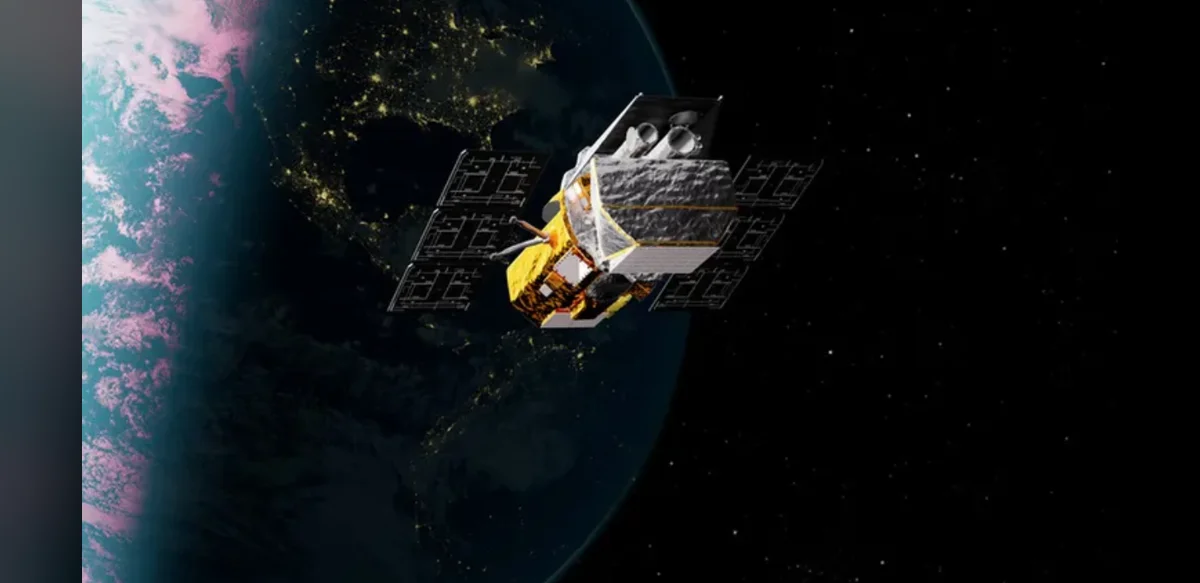
The Neil Gehrels Swift Observatory, a major NASA spacecraft dedicated to studying high-energy cosmic phenomena, completed its long-term mission by reentering the atmosphere after more than two decades in orbit. Launched in 2004, the observatory weighed approximately 3,200 pounds and played a central role in advancing knowledge of gamma-ray bursts and related astronomical events.
Throughout its operational life, the spacecraft identified more than 2,000 gamma-ray bursts, providing scientists with critical data on some of the universe’s most energetic occurrences. These observations contributed significantly to research in astrophysics and helped refine models of stellar explosions and black hole activity.
The end of the mission resulted from a gradual decline in orbital altitude caused by heightened solar activity, which increased atmospheric drag on the satellite. Despite efforts to adjust its trajectory, the spacecraft could not maintain its position and eventually began an uncontrolled descent.
NASA conducted a rescue attempt valued at around 30 million dollars aimed at restoring the observatory’s functionality and extending its service life. The operation, however, did not succeed in preventing the final reentry, which took place on November 4, 2026, over the region of Indonesia.
The Swift Observatory’s contributions remain an important part of the scientific record. Its instruments delivered continuous monitoring of transient celestial events, supporting both immediate alerts to the global astronomy community and long-term archival studies. Researchers continue to analyze the extensive dataset collected during its active years.
Reentries of decommissioned satellites are monitored by space agencies to assess risks and improve future mission planning. In this case, the event concluded a chapter in space-based gamma-ray astronomy while highlighting challenges associated with maintaining satellites in low Earth orbit amid varying solar conditions.
The mission’s legacy includes numerous peer-reviewed publications and collaborative projects involving international observatories. Data from Swift has been integrated into broader studies of cosmic evolution and high-energy particle physics, demonstrating the value of sustained space-based observation platforms.
As solar activity cycles continue to influence satellite lifetimes, agencies are exploring enhanced propulsion systems and orbit-raising techniques to mitigate similar outcomes in upcoming missions. The Swift experience offers practical lessons for designing resilient spacecraft capable of operating through periods of elevated solar output.
Public interest in the observatory’s conclusion reflects ongoing fascination with space exploration and the technologies that enable it. Educational outreach programs have used Swift’s story to illustrate concepts in orbital mechanics, astronomy, and international scientific cooperation.
In summary, the Neil Gehrels Swift Observatory fulfilled its primary objectives over 22 years before its atmospheric reentry marked the close of an era in gamma-ray astronomy. Its achievements in detecting and characterizing thousands of bursts underscore the enduring impact of dedicated space telescopes on our understanding of the cosmos.

