


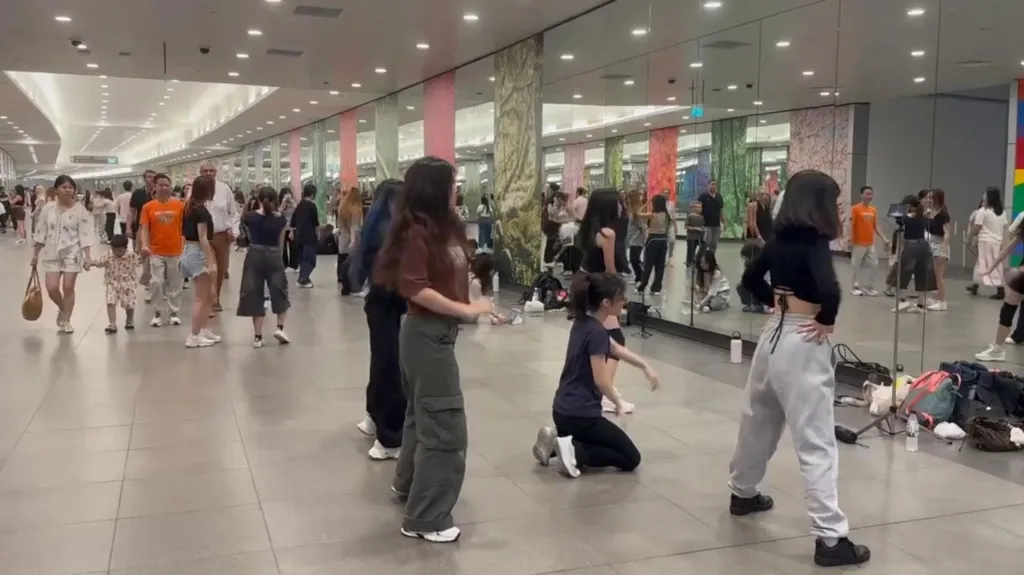
Until 1 January, when they showed up as usual only to find the mirrors frosted.
Hundreds of commuters and tourists walk through the spacious tunnel every day, many of them on their way to the city’s number-one attraction. People had complained that the dancers were “blocking pedestrian flow at this high-traffic area”, local media reported.
So, the mirrors were frosted,triggering a debate – not just about space, but also Singapore’s fixation with orderliness, the low bar for people to complain, and its many, many rules.
All of which arguably stifle the abandon, or even the havoc, that is often characteristic of the world’s biggest cities.
This is not the first time Singaporeans have crossed swords over how common spaces should be used in the land-scarce country, where more than 8,300 people jostle for each kilometre.
From whether frisbees should be allowed in parks, to benches fitted with dividers to deter rough sleepers, Singaporeans are often split on whose needs come first.
Additional restrictions are not the problem, says urban planning expert Tan Shin Bin from the National University of Singapore.
“[What should] give us pause is really whether the decision was a well-considered and fair one… Whose needs are being prioritised as legitimate, and whose desires are deemed secondary?”

