


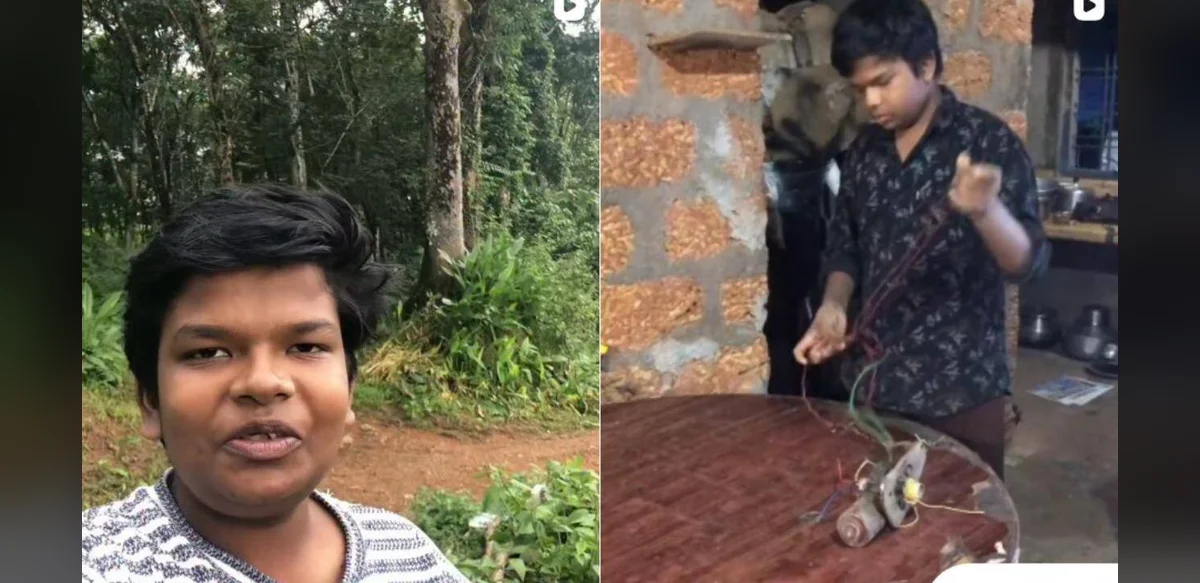
A twelve-year-old student from Kerala has drawn attention for constructing working machines and robotic devices using materials that most people discard. The youngster has produced several practical creations, among them a robot built primarily from cardboard and an automated device designed to stir food during cooking. These projects illustrate how everyday waste can be repurposed into tools that perform specific tasks.
One of the more recent projects involves a remote-controlled system for operating curtains. The device allows the user to open or close window coverings from a distance without manual effort. Observers who viewed demonstrations of the system shared the footage widely, noting the clear demonstration of problem-solving skills. The invention relies on basic electronic components combined with simple structural elements to achieve reliable movement.
The process behind these inventions begins with identifying a common household challenge and then experimenting with available materials to find a solution. Cardboard serves as the main structural base for many prototypes because it is lightweight, easy to cut and readily available. Additional parts such as small motors, switches and connecting wires are incorporated to add movement and control. Testing occurs through repeated adjustments until the mechanism operates consistently.
The automated food stirrer addresses the need for continuous mixing while cooking, reducing the requirement for constant attention at the stove. The design uses a rotating arm powered by a small motor mounted on a stable frame. This allows the device to maintain steady motion over a pot or pan. Early versions were refined through trial and error to ensure safety and effectiveness during use.
The cardboard robot demonstrates basic mobility and interaction. Constructed with minimal resources, it can perform simple actions such as moving forward or responding to basic commands. The project highlights how accessible materials can support introductory lessons in mechanics and electronics. Each iteration improves stability and range of motion.
Such hands-on activities encourage systematic thinking and persistence. The student has shown that ideas can progress from initial sketches to working models through steady experimentation. Community members and online viewers have expressed interest in the approach, suggesting that similar methods could inspire others to explore practical engineering at a young age.
The remote-controlled curtain mechanism further illustrates the application of control systems to everyday convenience. By integrating a receiver and actuator, the setup responds to signals sent from a handheld unit. Installation requires only basic mounting hardware, making it adaptable to standard window frames. The project underscores the potential for low-cost automation in residential settings.
Overall, the collection of inventions reflects a pattern of identifying needs, selecting suitable discarded items and assembling them into purposeful devices. Continued refinement of these prototypes may lead to additional functional improvements. The examples serve as concrete illustrations of how creativity combined with available resources can produce tangible results without specialized equipment.
Observers note that the work aligns with broader interest in practical skill development outside formal classroom settings. The projects remain focused on simple, replicable techniques that rely on observation and adjustment rather than advanced tools. This method allows the young inventor to document progress and share outcomes with others interested in similar pursuits.
The attention received online has prompted discussions about the value of early exposure to construction and problem-solving exercises. Viewers have remarked on the clarity of the demonstrations and the straightforward explanations provided alongside the videos. Such visibility may encourage additional young people to attempt their own small-scale engineering tasks using household materials.
In summary, the series of devices created by the Kerala student provides clear examples of transforming ordinary waste into operational machines. The cardboard robot, automated stirrer and remote curtain system each address distinct practical requirements through inventive assembly. The approach emphasizes experimentation, resourcefulness and iterative improvement, offering a model that others can study and adapt within their own environments.


