


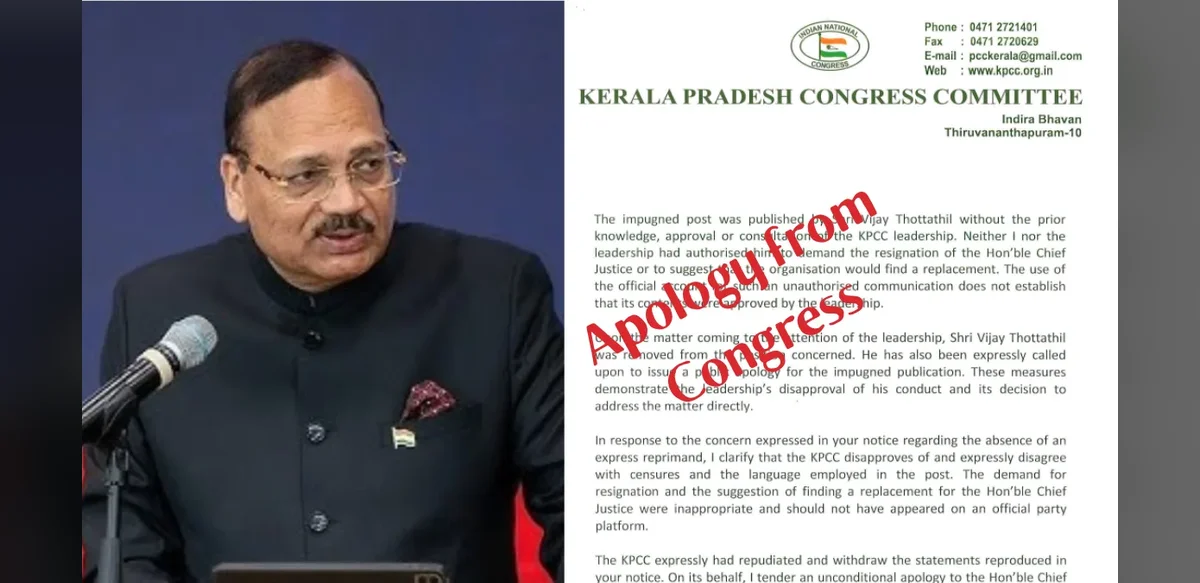
The Kerala unit of the Indian National Congress has issued an unconditional apology to the Chief Justice following an unauthorized social media post that drew criticism for its tone. The statement came after the post appeared on an official party account and was later removed amid public reaction. Party leaders emphasized that the content did not reflect the views of the organization or its senior members.
According to the response sent to a legal notice, the post originated from an individual who acted without approval from the state leadership. The person responsible was subsequently relieved of responsibilities related to digital communications. The committee clarified that no senior official had reviewed or endorsed the remarks before publication.
The incident involved a message posted in mid-October that questioned the Chief Justice and suggested the need for a replacement. Once the controversy emerged, the post was taken down promptly. The state president described the language as inappropriate and confirmed that it did not align with the party’s position on judicial matters.
In the detailed reply, the committee expressed regret for any disrespect conveyed and reaffirmed its commitment to the Constitution and the independence of the judiciary. It acknowledged that the episode highlighted gaps in oversight of social media operations and pledged to review access controls, approval processes, and the involvement of external agencies.
The committee also undertook to retain relevant records, including logs and internal communications, should any further inquiry arise. Leaders stressed that political differences should never justify statements that undermine the dignity of constitutional offices.
The apology was conveyed through the state president, who holds a ministerial position in the state government. The response noted that the expressions in the post were not authorized and did not represent the considered opinion of either the state or national leadership.
Observers noted that the episode prompted discussions within the party about strengthening internal protocols for public communications. The committee stated it would examine the entire workflow from drafting to publication to prevent similar occurrences.
Throughout the reply, emphasis was placed on respect for the judiciary and the importance of maintaining appropriate standards in public discourse. The party distanced itself from the specific demands made in the post and described them as contrary to its established approach.
The matter originated from a notice issued by a representative of the Supreme Court Bar Association. The committee responded by outlining the steps taken after the post appeared and the measures planned to improve accountability.
In summary, the Kerala Congress leadership has sought to close the chapter by offering a clear apology while committing to better safeguards in its digital operations. The episode serves as a reminder of the challenges parties face in managing official accounts and ensuring consistency with organizational values.
Further details from the response indicate that the committee will continue to monitor its communication channels closely. It recognized the distinction between legitimate criticism and language that crosses into disrespect. The leadership expressed hope that the corrective actions would address concerns raised by the incident.
The entire sequence of events unfolded over a period of roughly two weeks, beginning with the post and concluding with the formal apology. Throughout, the party maintained that the content was not sanctioned at any level of leadership.
This development underscores the sensitivity surrounding statements about judicial figures and the expectations placed on political organizations regarding public communications. The committee has signaled its intent to learn from the experience and strengthen internal procedures accordingly.

