


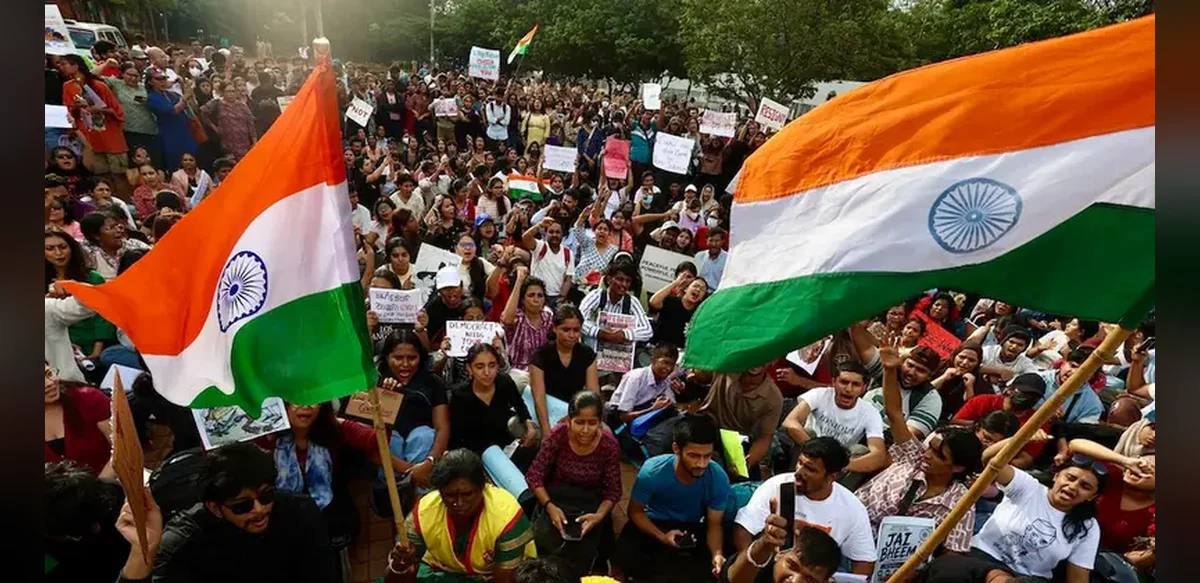
Student life inherently involves vitality that questions, challenges and opposes established norms. Inquiry has long been key to Indian learning traditions. Ancient education encouraged debate rather than suppressing it. Deep ideas developed through exchanges between mentors and learners, with questioning seen as vital for understanding.
Over time, student opposition broadened past academic matters. Young people increasingly challenged wider political and social problems, sparking movements that changed countries globally. Some reached their goals, others faded, and a few reshaped entire systems.
Before India’s freedom, Mahatma Gandhi noted that if post-independence governments acted unjustly, the next generation would confront the order. He said he would support them.
Events followed his prediction. The first post-independence generation, especially students, started one of India’s major popular campaigns. What began as a campus protest grew into a national democratic revolt that led to the Emergency and changed India’s politics. It became known as the Navnirman Movement.
The Navnirman Movement: From campus action to national change
In 1973-74, a minor issue sparked events. Officials at LD College of Engineering in Gujarat raised hostel dining fees due to higher groundnut oil costs. That year Gujarat had a large groundnut crop, its main export.
Basic economics indicate more supply should lower prices if demand stays steady. Prices rose anyway due to black marketing, hoarding, fake shortages and monopoly tactics common then.
Students saw the inconsistency and protested what they called corruption and poor administration.
Political groups soon joined. Opposition parties and Congress rivals reportedly spread a recording allegedly showing Gujarat’s chief minister discussing hoarding and price control with traders.
The campus protest quickly became a state-wide effort. Corruption claims merged with calls for accountability and reform.
Around the same period, student protests arose in Bihar. As the effort outgrew student groups, socialist leader Jayaprakash Narayan took charge. Under him it became a national drive against corruption and authoritarian rule.
Ideas from socialists like Narayan and Ram Manohar Lohia, plus the socialist leanings of student leaders from Bihar and Uttar Pradesh, shaped the movement’s identity.
These events led to the 1975 Emergency, then the Janata Party and India’s first non-Congress central government. Yet many leaders from the movements later joined the system they had opposed.
Umakant Mankad, a key Gujarat organizer, later joined Congress, the party he had targeted. His career stalled, and public anger was so strong he was reportedly attacked by citizens who saw it as betrayal.
Similar patterns occurred in Bihar and Uttar Pradesh. Leaders like Mulayam Singh Yadav, Lalu Prasad Yadav, Nitish Kumar and Ravi Shankar Prasad rose from the movement. Some reached high office, but others including Lalu Prasad Yadav and Mulayam Singh Yadav faced corruption charges, becoming examples of the culture they had promised to end.
The Navnirman Movement showed both the strength and the contradiction of student politics: campaigns can topple governments, yet leaders often fail to keep their original principles once inside the system.

