


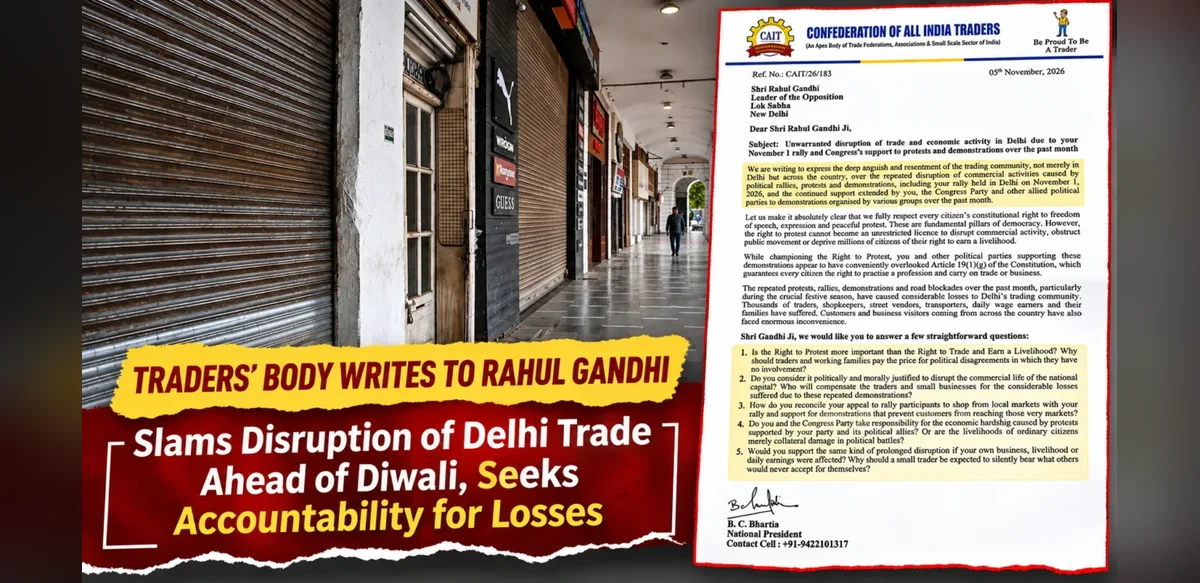
The Confederation of All India Traders has expressed strong criticism toward Congress leader Rahul Gandhi regarding recent political events in the national capital that affected business operations. In a formal communication dated November 5, the organization highlighted concerns from the trading community about repeated interruptions to commercial activities in Delhi over the preceding weeks.
The letter specifically referenced a large gathering organized by the INDIA bloc at Ramlila Maidan on November 1. Organizers proceeded with the event despite prior requests from business representatives to delay it until after the Diwali festival period. Traders noted that the timing coincided with key shopping days, including Dhanteras on November 6 and Diwali on November 8, which typically generate significant revenue for small vendors and shop owners.
Business groups had contacted Congress representatives in advance to discuss potential impacts. They pointed out that numerous wholesale and retail markets lie within a short distance of the venue, including areas such as Chandni Chowk, Sadar Bazar, Chawri Bazar, Khari Baoli, Bhagirath Palace, Kashmere Gate, Karol Bagh, and Lajpat Rai Market. Concerns centered on road closures, security measures, and traffic diversions that could deter customers from visiting these locations.
Estimates from trade associations suggested that the disruptions might result in losses reaching up to 10,000 crore rupees during the peak festive season. Requests for meetings with senior party figures to explore alternative dates after November 10 did not lead to changes in the schedule. The event took place as planned on November 1.
Following the gathering, additional comments from the opposition leader suggested that attendees could combine participation with visits to local shops. This proposal aimed to support businesses but drew questions from traders about practicality, given the expected access limitations around the venue. Observers noted that large crowds and associated restrictions often reduce footfall rather than increase it.
Separate remarks during travel to the site alleged that certain shops in Connaught Place had been closed due to actions by the ruling party. Such statements introduced a political element to what trade bodies described primarily as an economic issue. Distinguishing between security protocols, administrative decisions, and partisan claims remains important for understanding the full context of shop closures.
The November 5 letter posed several direct questions to the opposition leader. These included whether the right to hold demonstrations outweighs the right to conduct trade and earn a living. The organization also asked why business owners and workers should bear costs from political activities in which they played no direct role. Further points addressed the justification for affecting the commercial functioning of the capital and sought clarity on compensation for affected parties.
Trade representatives emphasized that their position does not oppose the principle of peaceful assembly. Instead, they advocated for better coordination to minimize effects on daily livelihoods, particularly during limited high-revenue periods. Small shopkeepers and daily wage earners rely heavily on festival sales to offset quieter months throughout the year.
The episode has prompted broader discussion about balancing political expression with economic considerations in densely populated urban centers. Similar events in the past have occasionally led to calls for improved planning between organizers and local business communities. In this instance, the focus remains on the specific timing relative to major cultural and commercial occasions.
Delhi authorities managed security and traffic arrangements around the venue, resulting in temporary restrictions that influenced movement in surrounding areas. Market associations reported lower than expected customer turnout on the day of the event and in the immediate aftermath. Recovery of lost sales proved challenging for many operators already navigating seasonal fluctuations.
The Confederation of All India Traders continues to represent interests of merchants nationwide and has urged political groups to consider such factors in future scheduling. The letter concluded by requesting responses to the raised points within a reasonable timeframe. No immediate reply from the addressed party has been reported in available updates.
This situation illustrates ongoing tensions between political mobilization and commercial stability in India’s capital. Stakeholders from various sectors have called for dialogue mechanisms that allow expression of views while protecting economic activities essential to urban populations. Future events may benefit from earlier consultations to identify mutually acceptable arrangements.

