


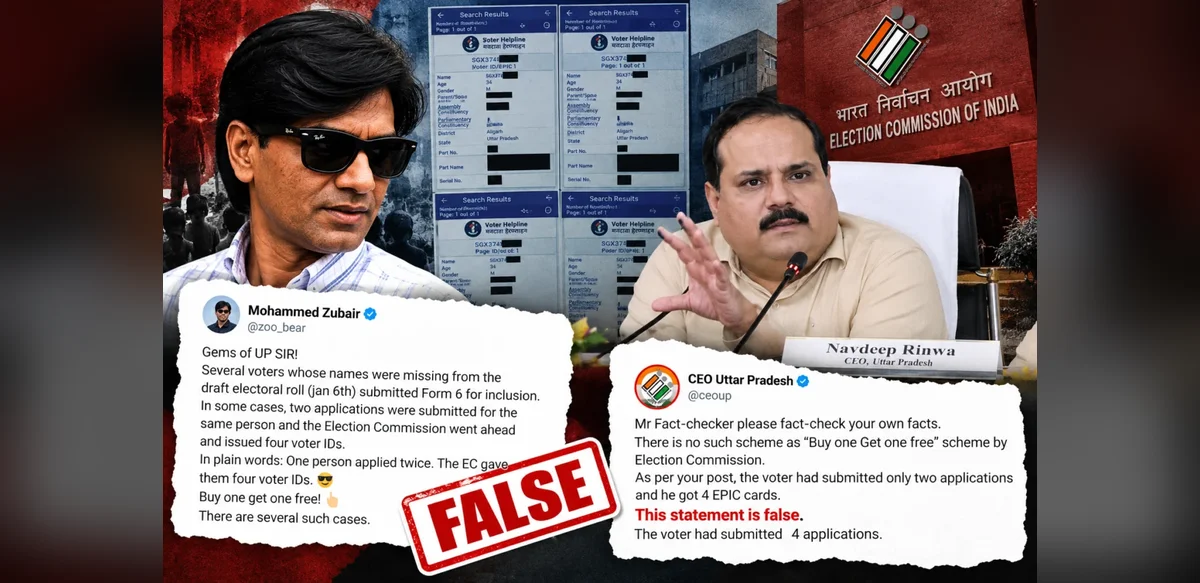
The Chief Electoral Officer of Uttar Pradesh has issued a public response to an online allegation concerning the issuance of voter identity documents. The claim suggested that election authorities had provided four separate Electoral Photo Identity Cards after receiving only two applications for enrollment in the voter list. According to the officer the assertion does not match the records and misrepresents the actual sequence of submissions.
The original post had referred to several individuals whose names were absent from a draft electoral roll released earlier in January. It stated that these persons had completed Form 6 to request inclusion. In one highlighted instance the post indicated that two such forms were filed for the same person yet four cards were eventually generated. The language used described the outcome as resembling a promotional offer in which extra items are supplied without additional requests.
In reply the state election office clarified that the individual involved had actually submitted four separate applications rather than two. The officer invited the person making the claim to supply the reference numbers of the two forms mentioned in the post. If those numbers are provided the office stated it would release the reference numbers for the remaining two applications to demonstrate the complete record.
The response emphasized that no policy exists under which extra cards are issued automatically. It described the situation as a factual error and advised that any public statement should be verified before publication. The office further noted that the generation of duplicate cards following multiple submissions by one person has been recognized as an ongoing administrative issue for some time.
To address this the Election Commission operates a digital system known as ECINET that performs periodic checks to identify and remove duplicate entries. Officials indicated that work is underway to detect repeated submissions at the moment an application is first received rather than after cards have already been produced. They expressed confidence that this preventive step will be implemented in the near future.
The officer also cautioned against statements that could reduce public trust in the constitutional body responsible for managing elections. The response suggested that the person who posted the claim should review the clarification and consider updating or removing the original post once the additional information has been examined.
This exchange highlights the broader challenge of maintaining accurate voter rolls when individuals submit multiple requests. While the specific case was disputed the acknowledgment of duplicate applications as a persistent concern shows that authorities continue to refine their verification procedures. The digital platform is used at regular intervals to cross reference entries and reduce the number of redundant cards in circulation.
Observers note that such disputes between fact checking accounts and election administrators are not uncommon during periods of voter list revision. Both sides present differing interpretations of the same set of documents and reference numbers. The invitation to exchange specific reference numbers offers a potential path to resolve the disagreement through direct comparison of records.
The Chief Electoral Officer reiterated that the Election Commission remains committed to improving the accuracy of the electoral process. Efforts to catch duplicate forms at the initial submission stage are described as a priority that will reduce the need for later corrections. Until those improvements are fully operational periodic deduplication through the existing digital tools will continue.
Public communication from the office stressed the importance of accurate reporting when discussing the functioning of constitutional institutions. It advised that allegations should be supported by complete documentation before being shared widely. The response concluded by offering further clarification if the requested reference numbers are supplied.
Overall the episode illustrates the detailed administrative work involved in maintaining voter lists and the mechanisms used to handle multiple applications from the same person. The exchange between the election office and the online account provides an example of how factual disagreements can be addressed through requests for specific supporting evidence rather than general assertions.

