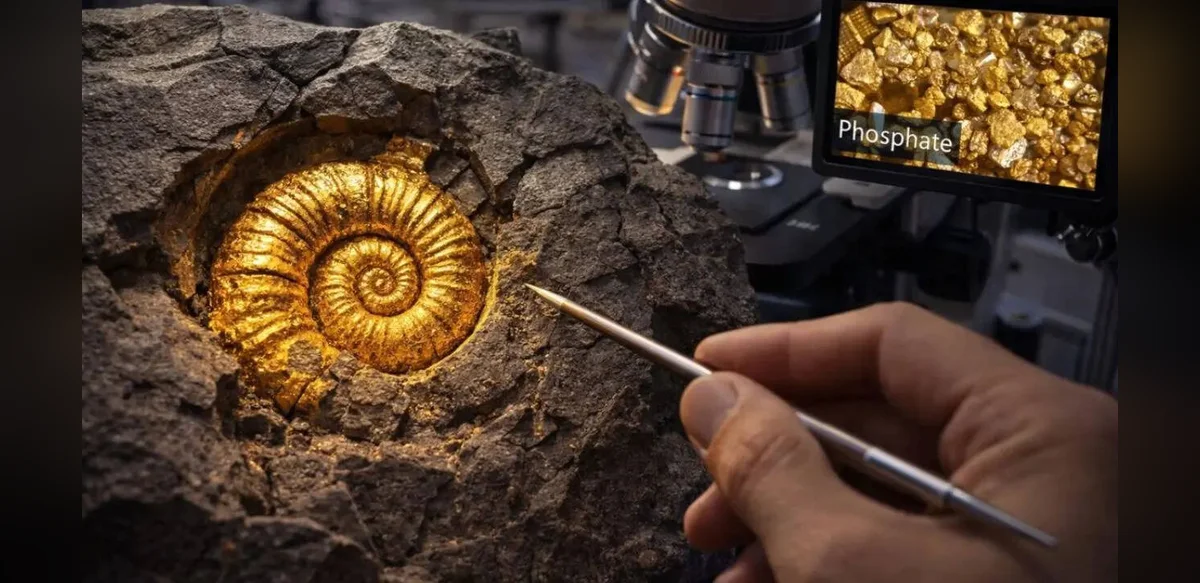
A fossil from 183 million years ago, discovered in black shale formations in southwestern Germany, has long deceived researchers with its golden appearance. Primarily ammonites, these specimens were traditionally viewed as examples of pyritization, where organic matter is substituted by pyrite, a mineral resembling gold due to its luster. This explanation was commonly accepted.
Recent studies, however, have overturned this view. Through detailed examination with scanning electron microscopy, experts discovered minimal pyrite in the fossils themselves. Some samples contained just a few small crystals.
The fossils consist mainly of phosphate minerals, a result of phosphatization. This method preserves organic material quickly, before significant decay, and often maintains intricate details lost in other preservation types. Thus, the fossils lack a metallic makeup despite their visual shine.
The golden effect originates from the enclosing black shale, which holds numerous microscopic pyrite formations known as framboids. These reflective clusters scatter light, producing a metallic glow that makes the fossil appear shiny. Analysis showed hundreds of framboids in the surrounding rock, compared to very few within the fossil.
These remains date to the Toarcian Oceanic Anoxic Event, a period 183 million years ago marked by widespread low oxygen levels in oceans. Such conditions likely slowed decay, aiding exceptional preservation.
Research indicates brief periods of higher oxygen may have triggered chemical processes, allowing phosphates to replace biological tissues before breakdown. While low oxygen typically supports preservation by reducing decomposition, these short oxygen increases appear key.
This finding reshapes understanding of the Posidonia Shale, a key site in paleontology. Errors in interpreting its preservation could affect studies of similar locations globally.
The discovery also holds modern significance, as ocean oxygen levels have dropped about 2% since the mid-20th century. Insights from past events could help forecast future changes.