


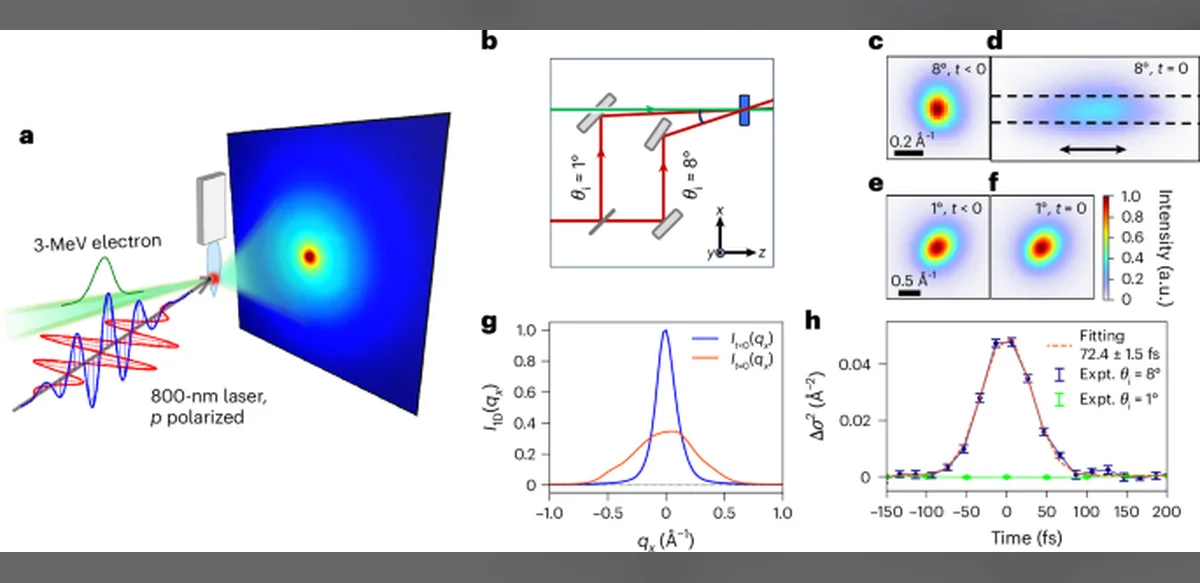
A team of researchers has successfully shown that intense laser fields can streak megaelectronvolt electrons traveling through a liquid medium. This marks an important step in understanding how light interacts with charged particles outside traditional vacuum settings. The work, published in Nature Photonics, clarifies that the observed streaking arises from a dielectric-mediated electron-light interaction. It does not result from plasma lensing effects that might have been expected in such an environment.
Electron streaking techniques have long been used in vacuum to measure ultrafast processes. Extending these methods into liquids opens possibilities for studying phenomena in more natural or applied conditions. The experiment involved directing laser pulses at electrons with energies in the megaelectronvolt range while they moved through the liquid. Careful measurements revealed clear streaking patterns that matched theoretical predictions based on dielectric responses rather than plasma formation.
The distinction between dielectric mediation and plasma lensing is significant. Plasma lensing typically occurs when ionized particles create focusing or defocusing effects. In contrast, the dielectric mechanism involves the liquid’s response to the electric field of the laser without requiring ionization. By identifying this origin, the researchers provide a clearer framework for interpreting similar experiments in condensed matter.
Further analysis pinpointed specific experimental conditions where the streaking effect can be minimized or eliminated. Adjustments to laser intensity, pulse duration, and liquid properties allowed the team to suppress the streaking. These findings offer practical guidance for future studies aiming to isolate or control electron-light interactions in liquids.
The results contribute to broader efforts in ultrafast science and laser-particle physics. Understanding how electrons behave in liquids under strong laser fields may inform developments in radiation detection, medical imaging, and materials processing. The work also highlights challenges unique to non-vacuum environments, such as scattering and energy loss, that must be accounted for in experimental design.
Background on the field notes that previous streaking experiments focused primarily on gaseous or vacuum targets. Liquids introduce additional complexity due to higher density and molecular interactions. The current demonstration shows that controlled streaking remains achievable despite these factors when the interaction mechanism is properly understood.
The researchers emphasize that their observations were reproducible across multiple trials. Data analysis ruled out alternative explanations involving plasma effects by comparing outcomes under varying pressure and temperature conditions. This rigorous approach strengthens confidence in the dielectric interpretation.
Looking ahead, the ability to manipulate electron trajectories in liquids could support new diagnostic tools. For instance, streaking might serve as a probe for local electric fields or material properties at microscopic scales. Continued refinement of suppression techniques may also help reduce unwanted artifacts in related measurements.
Overall, the study advances knowledge of light-matter interactions in dense media. It provides both a foundational observation and actionable insights for controlling such processes. Future investigations building on these results are expected to explore a wider range of liquids and electron energies.
The publication has drawn attention from the photonics and accelerator communities. Experts note that bridging vacuum-based techniques with liquid environments represents a meaningful expansion of experimental capabilities. While the current work focuses on fundamental mechanisms, its implications extend to applied research areas requiring precise electron control.
In summary, the demonstration of laser-induced streaking in liquids, its dielectric origin, and the identified suppression conditions establish a new reference point for the field. The findings underscore the importance of mechanism-specific analysis when moving ultrafast techniques into complex media.

