


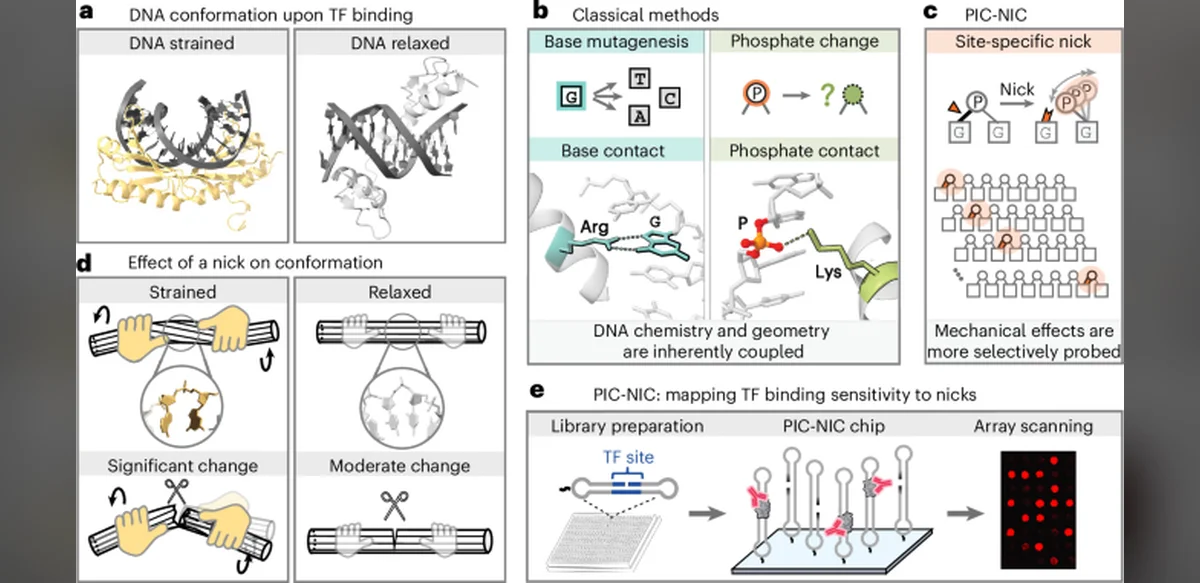
A research team led by Yao and colleagues has introduced a novel high-throughput method called PIC-NIC that uses targeted DNA nicks to explore the role of local mechanical strain in how transcription factors interact with DNA. The work, published in Nature Structural & Molecular Biology, demonstrates that physical properties of DNA can affect protein recognition in ways that go beyond the genetic sequence itself.
Transcription factors are proteins that bind to specific DNA regions to control gene activity. While the nucleotide sequence has long been recognized as a key determinant of these interactions, emerging evidence suggests that mechanical features such as tension, bending, or twisting also play important roles. The PIC-NIC platform was designed to systematically investigate these effects across many different protein-DNA combinations.
The method relies on introducing precise single-strand breaks, or nicks, at chosen locations within DNA molecules. These nicks create localized changes in mechanical strain without altering the underlying sequence. By applying this approach in a high-throughput format, the researchers were able to test numerous conditions and map how strain variations influence binding affinity for a range of transcription factors.
Experiments conducted with the platform revealed that mechanical strain can either enhance or reduce the ability of transcription factors to recognize their target sites, depending on the specific protein-DNA interface involved. The findings indicate that these physical effects operate across diverse molecular contexts rather than being limited to a narrow set of cases.
The development of PIC-NIC addresses a longstanding challenge in the field: the difficulty of isolating and measuring mechanical contributions to binding specificity in a scalable manner. Traditional techniques often examine one interaction at a time or require complex instrumentation that limits throughput. The new platform overcomes some of these constraints by combining site-specific nicking with systematic screening.
Researchers note that understanding mechanical influences on transcription factor recognition could provide new insights into gene regulation mechanisms. Because DNA inside cells experiences various forms of strain due to packaging, supercoiling, and interactions with other molecules, the physical environment may modulate regulatory events in previously underappreciated ways.
The study tested multiple transcription factors and DNA sequences to ensure the observed effects were not restricted to particular systems. Results showed consistent patterns in which local strain altered binding outcomes, supporting the broader relevance of mechanical factors in protein-DNA recognition.
Future applications of the PIC-NIC approach may include investigations into how mutations or environmental conditions that change DNA mechanics affect gene expression. Such work could eventually inform studies of developmental processes, cellular responses to stress, or disease states linked to regulatory dysfunction.
The platform is presented as a tool that can be adapted for additional experiments exploring mechanical biology. Its design allows for controlled introduction of strain at defined positions, enabling researchers to build more complete models of how sequence and structure together determine molecular interactions.
Overall, the introduction of PIC-NIC represents a technical advance that expands the experimental toolkit available for studying the physical dimensions of gene regulation. By focusing on mechanical strain in a high-throughput and systematic fashion, the method opens avenues for deeper understanding of transcription factor behavior beyond what sequence analysis alone can reveal.

