


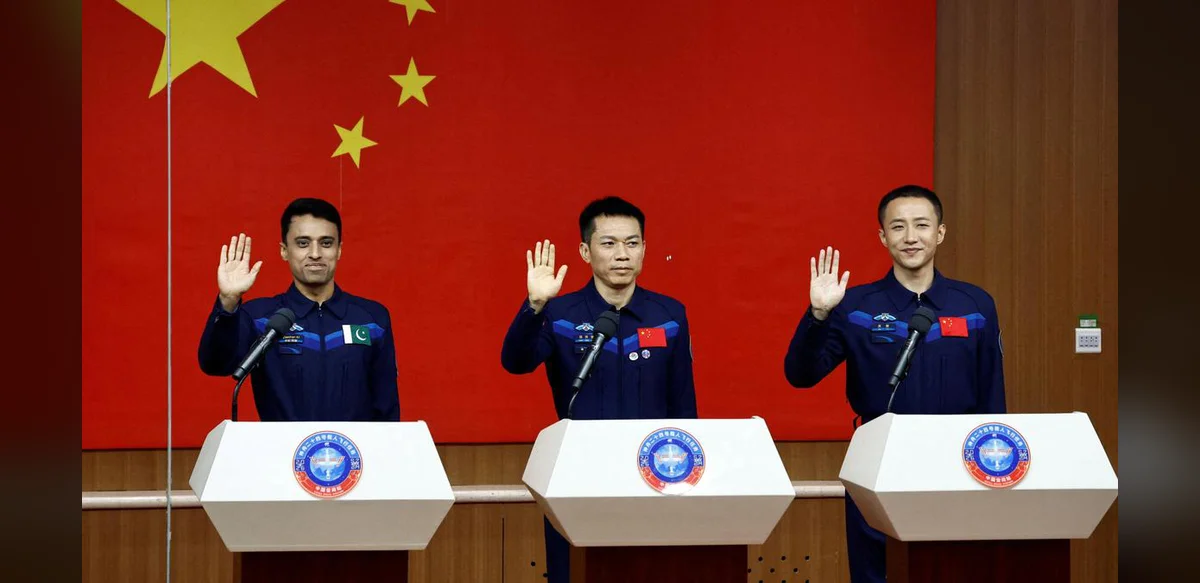
China has confirmed that its Shenzhou-24 spacecraft will feature a payload specialist from Pakistan. This development represents the initial inclusion of an astronaut from that nation in one of the country’s crewed space missions.
The specialist in question, identified as Zeeshan Ali, is scheduled to take part in the flight. Details indicate that the arrangement arises from ongoing cooperative arrangements between the involved countries.
Such participation aligns with joint efforts connected to the Belt and Road Initiative promoted by Beijing. The initiative encompasses various collaborative projects across multiple sectors, including scientific endeavors.
Observers note that this step could highlight expanding ties in the field of space activities. Missions of this nature typically involve extensive preparation and coordination among participating entities.
The Shenzhou series has formed a core component of China’s human spaceflight program over the years. Each iteration builds upon prior achievements to advance capabilities in orbital operations.
Payload specialists contribute specialized expertise during flights, focusing on experiments and equipment management. Their roles complement those of the core crew members responsible for spacecraft operations.
Bilateral space cooperation often includes training programs and knowledge exchange. These activities aim to strengthen technical capacities on both sides.
The announcement comes amid broader discussions on global space partnerships. Nations continue to explore avenues for shared projects that promote mutual interests in scientific advancement.
Further information regarding the mission timeline and specific objectives is expected in subsequent updates from official sources. Such details will provide additional context on the flight parameters and research goals.
Overall, the inclusion of the Pakistani specialist underscores the international dimension of contemporary space exploration efforts. It reflects a pattern of increasing participation from various countries in major aerospace initiatives.
Analysts suggest that continued collaboration may lead to additional joint ventures in the future. These could encompass satellite technology, research stations, and crewed expeditions beyond low Earth orbit.
The Belt and Road Initiative serves as a framework for many such partnerships. It facilitates connections in infrastructure, trade, and now increasingly in high-technology domains like space science.
Preparation for space missions involves rigorous selection processes and simulation training. Participants undergo evaluations to ensure readiness for the demands of orbital environments.
Public interest in space programs remains high worldwide. Announcements like this one often generate discussions on the benefits of cross-border scientific work.
China’s space agency has steadily expanded its roster of international engagements. This latest development adds another chapter to that progression.
The mission’s success will depend on seamless integration of all team members and systems. Coordination across borders presents both opportunities and logistical considerations.
In summary, the planned participation marks a notable milestone in the partnership between the two nations. It opens pathways for deeper involvement in space-related activities moving forward.

